
COMICBOOKSTOCKEXCHANGE.COM·
UTC LIVE TIMEDEAL RADAR
MARKET CLOCKS
HOME OFFICEHOME OFFICE--:--
NYSENew York--:--
LSELondon--:--
JPX / NIKKEITokyo--:--
DFM / ADXDubai--:--
WORLD / UTC--:--
Marvel·Captain America·#135·Bronze Age·ID-3229194
| Grade | Census & Float Distribution | Copies / Slabs | Role | FMV | Sales | Total Value | Multiple |
|---|---|---|---|---|---|---|---|
| 9.8 | 15 of 205 slabs (7.3%) | 15 | SOV | $434.50 | 2 | $6,518 | (34.8x) |
| 9.6 | 40 of 205 slabs (19.5%) | 40 | $131.27 | 9 | $5,251 | (10.5x) | |
| 9.4 | 42 of 205 slabs (20.5%) | 42 | ANC | $122.00 | 5 | $5,124 | (9.8x) |
| 9.2 | 32 of 205 slabs (15.6%) | 32 | $99.00 | 8 | $3,168 | (7.9x) | |
| 9.0 | 13 of 205 slabs (6.3%) | 13 | $62.98 | 2 | $818.74 | (5.0x) | |
| RAW | Raw Uncertified Copies | 36,365 | RAW | $12.50 | 28 | $454,563 | (1.0x Base) |
Empirical cash settlement intelligence, cross-grade elasticity curve, and secondary liquidation velocity.
Empirical step multipliers between adjacent condition tiers. Pinpoints the exponential premium transition and capital efficiency frontier.
Realized turnover cadence and capital absorption depth across certified auction comps.
Autonomous institutional strategies, financial equilibrium, scarcity modeling, and algorithmic risk profiling.
Market operates purely on organic buyer and seller auction discovery. Zero artificial price interventions or emergency liquidity halts on record.
Verified historical transaction line with quarterly equilibrium baseline anchor.
Understand how physical sales, invested dollars, and liquidity friction divide across grades.
Completed market sales by grade
Relative market value allocation
Estimated execution friction
Bibliographic provenance, creator credits, historical significance, and multimedia documentation.
? (ad copy)
?; ? (photographs)
?; ? (photographs)
? (background only)
? (ad agency)
Home of Spider-Man, X-Men, Avengers, and the Marvel Cinematic Universe.
Comics grow darker and more socially aware. Wolverine, Punisher, Swamp Thing debut. Creator-driven storytelling emerges.
Newsstand variants carry meaningful scarcity premiums. First appearances from this era are blue-chip investments.
Bronze Age (1970–1984) — comics grew darker and more socially aware. The era of classic runs, creator-driven storytelling, and the birth of serious collecting culture. Newsstand variants carry a meaningful scarcity premium.
Inspectable mathematical proof, blockchain/ledger provenance, data integrity validation, and asset taxonomy.
A pricing discrepancy between an auction listing and the prevailing cleared consensus value across organized exchanges, allowing rapid liquidity capture before market equilibrium reconverges.
At SHIELD headquarters, Captain America arrives to an immediate sense of urgency rather than ceremony. Nick Fury quickly folds him into active operations, and Cap reconnects with the Falcon as his field partner. Their banter is warm and confident, but the atmosphere around them suggests pressure building beneath the surface. Fury moves them toward the combat area, where readiness matters more than introductions. As Cap and Falcon settle into the rhythm of SHIELD life, the story cuts to Dr. Erik Gorbo, a biochemist whose intelligence is matched by deep resentment. He feels dismissed by the very institution he serves. While the heroes focus on teamwork and discipline, Gorbo turns inward, nursing professional humiliation and planning an experiment meant to prove his superiority. The contrast is sharp: one side is trust and partnership, the other isolation and ego. Falcon’s training sequence becomes a key character moment. In a timed sparring challenge against heavier opposition, he relies on speed, anticipation, and precision instead of raw force. He wins decisively, proving he belongs beside Cap as a true equal in tactical value. The page-to-page effect is deliberate: as one man validates himself through skill and teamwork, another seeks validation through secrecy and reckless science. Gorbo injects himself with an ape-based formula meant to enhance strength. The result is catastrophic. His body mutates beyond control into a giant gorilla-like form, and panic overtakes him as he realizes he may be trapped in this monstrous state. Yet his mind does not fully collapse. He is terrified, but still calculating. He scrambles for an antidote, finds a way to reverse the transformation temporarily, and regains human appearance just long enough to hide what happened. That brief return to normal does not restore his morality. It hardens him. After an awkward interaction in the lab that reinforces his feelings of humiliation and social alienation, Gorbo chooses a darker path. He refines the formula and learns he can move between forms through controlled dosing. Worse, he discovers a second ability: he can influence and command animals, especially aggressive ones. This turns him from a tragic experiment into a strategic predator. With this new power set, he begins committing crimes in ape form while preserving his scientist identity as cover. The scheme is elegant in a sinister way: law enforcement hunts a beast, while the man behind it remains invisible in plain sight. During a major robbery, he uses brute force to break through defenses and animal control to disrupt pursuit, unleashing dogs to create chaos among officers and bystanders. The public sees madness; Gorbo is executing a plan. Reports spread quickly, and the city becomes consumed by fear and confusion. A giant gorilla robber is alarming enough, but the coordinated use of animals makes the attacks feel almost supernatural. Cap and Falcon pursue, and Cap quickly notices what others miss: this is not random animal violence. The gorilla moves with intent, picks moments carefully, and adapts under pressure. There is intelligence inside the brutality. Meanwhile, SHIELD activities continue around Project Earth Dig, a high-stakes scientific operation with symbolic and strategic value. Gorbo identifies it as the ideal target for escalation. If he can strike there, he can move from dramatic crime to national-level disruption. The attack comes fast and hard. In ape form, he tears into critical structure, triggering collapse hazards and forcing emergency responses across the site. Cap engages him in a dangerous vertical battleground of rigging, platforms, and cables, where every blow risks collateral catastrophe. The fight is no longer just hero versus villain; it is also a race to prevent mass casualties. Cap has to split focus between stopping the attacker and protecting workers below. Gorbo, still driven by bitterness and grandiosity, fights with unsettling tactical awareness, further confirming he is far more than a mindless creature. As the structure destabilizes, both men lose secure footing. In the chaos, they fall together into the massive excavation shaft, plunging toward the depths of the project’s central pit. The ending lands as a hard cliffhanger: the hero and the monster disappear into the same abyss, unresolved and still locked in conflict. Taken as a whole, this stretch of the story is about wounded ambition mutating into calculated monstrosity. It pairs physical spectacle with psychological motive, giving the villain a deeply personal grievance that curdles into danger for everyone around him. It also strengthens the Cap-Falcon partnership by showing competence under pressure and mutual trust in rapidly shifting situations. By the final page, the narrative has expanded from SHIELD tension and localized crime into full-scale disaster stakes, setting up the next chapter as both survival test and truth-reveal waiting to happen.
Each cover variant, retailer incentive, and subsequent printing represents an independent atomic tradeable instrument with unique supply elasticity, barcode registration, and secondary market demand.
Strict algorithmic segregation separating clean single-issue Cover A sales from multi-issue lot bundles, retailer exclusives, and foreign variants.

Captain America #1
9.8
$229.99
9.6
—
9.4
—
RAW
$2.49
Captain America #1
9.8
$175.00
9.6
—
9.4
—
RAW
$63.00
Captain America #1
9.8
$143.53
9.6
—
9.4
—
RAW
$55.87
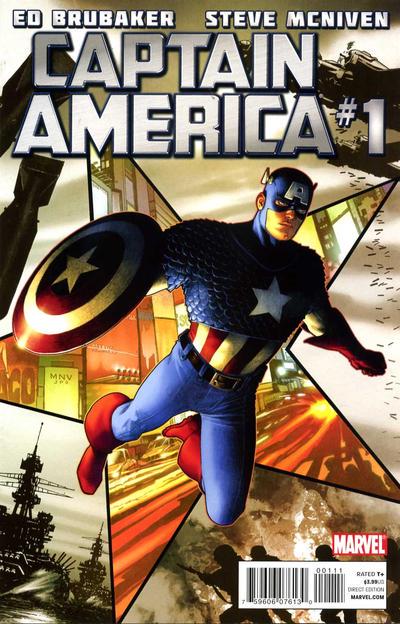
Captain America #1
9.8
$112.50
9.6
—
9.4
—
RAW
$8.99
Captain America #1
9.8
$109.98
9.6
—
9.4
—
RAW
$4.84
Captain America and the Falcon battle Dr. Erik Gorbo, a SHIELD scientist who has gone on a crime spree after turning himself into a monster ape.
Ad for U.S. coin catalog.
Miscellaneous ads from various dealers. Includes comics ad from Howard M. Rogofsky.
Miscellaneous ads from various dealers. Includes back-issue comics ads.
Ad for free "Drafting Career Kit".
“Nick, shake hands with the Falcon -- my new partner.”
At SHIELD headquarters, Captain America arrives to an immediate sense of urgency rather than ceremony. Nick Fury quickly folds him into active operations, and Cap reconnects with the Falcon as his field partner. Their banter is warm and confident, but the atmosphere around them suggests pressure building beneath the surface. Fury moves them toward the combat area, where readiness matters more than introductions.
As Cap and Falcon settle into the rhythm of SHIELD life, the story cuts to Dr. Erik Gorbo, a biochemist whose intelligence is matched by deep resentment. He feels dismissed by the very institution he serves. While the heroes focus on teamwork and discipline, Gorbo turns inward, nursing professional humiliation and planning an experiment meant to prove his superiority. The contrast is sharp: one side is trust and partnership, the other isolation and ego.
Falcon’s training sequence becomes a key character moment. In a timed sparring challenge against heavier opposition, he relies on speed, anticipation, and precision instead of raw force. He wins decisively, proving he belongs beside Cap as a true equal in tactical value. The page-to-page effect is deliberate: as one man validates himself through skill and teamwork, another seeks validation through secrecy and reckless science.
Gorbo injects himself with an ape-based formula meant to enhance strength. The result is catastrophic. His body mutates beyond control into a giant gorilla-like form, and panic overtakes him as he realizes he may be trapped in this monstrous state. Yet his mind does not fully collapse. He is terrified, but still calculating. He scrambles for an antidote, finds a way to reverse the transformation temporarily, and regains human appearance just long enough to hide what happened.
That brief return to normal does not restore his morality. It hardens him. After an awkward interaction in the lab that reinforces his feelings of humiliation and social alienation, Gorbo chooses a darker path. He refines the formula and learns he can move between forms through controlled dosing. Worse, he discovers a second ability: he can influence and command animals, especially aggressive ones. This turns him from a tragic experiment into a strategic predator.
Beginning this issue, Falcon (Sam Wilson) becomes the co-star of this title. He will remain so until Captain America Vol 1 222. This issue features a letters page, Let's Rap With Cap. Letters are published from Guy Lillian Roger W. Norris, Steve Demeo, and Tony McDonald. This issue also features advertisments for the crossover event in Iron Man Vol 1 35 and Daredevil Vol 1 73.
With this new power set, he begins committing crimes in ape form while preserving his scientist identity as cover. The scheme is elegant in a sinister way: law enforcement hunts a beast, while the man behind it remains invisible in plain sight. During a major robbery, he uses brute force to break through defenses and animal control to disrupt pursuit, unleashing dogs to create chaos among officers and bystanders. The public sees madness; Gorbo is executing a plan.
Reports spread quickly, and the city becomes consumed by fear and confusion. A giant gorilla robber is alarming enough, but the coordinated use of animals makes the attacks feel almost supernatural. Cap and Falcon pursue, and Cap quickly notices what others miss: this is not random animal violence. The gorilla moves with intent, picks moments carefully, and adapts under pressure. There is intelligence inside the brutality.
Meanwhile, SHIELD activities continue around Project Earth Dig, a high-stakes scientific operation with symbolic and strategic value. Gorbo identifies it as the ideal target for escalation. If he can strike there, he can move from dramatic crime to national-level disruption. The attack comes fast and hard. In ape form, he tears into critical structure, triggering collapse hazards and forcing emergency responses across the site.
Cap engages him in a dangerous vertical battleground of rigging, platforms, and cables, where every blow risks collateral catastrophe. The fight is no longer just hero versus villain; it is also a race to prevent mass casualties. Cap has to split focus between stopping the attacker and protecting workers below. Gorbo, still driven by bitterness and grandiosity, fights with unsettling tactical awareness, further confirming he is far more than a mindless creature.
As the structure destabilizes, both men lose secure footing. In the chaos, they fall together into the massive excavation shaft, plunging toward the depths of the project’s central pit. The ending lands as a hard cliffhanger: the hero and the monster disappear into the same abyss, unresolved and still locked in conflict.
Taken as a whole, this stretch of the story is about wounded ambition mutating into calculated monstrosity. It pairs physical spectacle with psychological motive, giving the villain a deeply personal grievance that curdles into danger for everyone around him. It also strengthens the Cap-Falcon partnership by showing competence under pressure and mutual trust in rapidly shifting situations. By the final page, the narrative has expanded from SHIELD tension and localized crime into full-scale disaster stakes, setting up the next chapter as both survival test and truth-reveal waiting to happen.