COMICBOOKSTOCKEXCHANGE.COM·
UTC LIVE TIMEDEAL RADAR
MARKET CLOCKS
HOME OFFICEHOME OFFICE--:--
NYSENew York--:--
LSELondon--:--
JPX / NIKKEITokyo--:--
DFM / ADXDubai--:--
WORLD / UTC--:--
Independent·Kull the Conqueror·#1·Bronze Age·ID-3739699
| Grade | Census & Float Distribution | Copies / Slabs | Role | FMV | Sales | Total Value | Multiple |
|---|---|---|---|---|---|---|---|
| 9.8 | 36 of 655 slabs (5.5%) | 36 | SOV | $528.00 | 1 | $19,008 | (52.9x) |
| 9.6 | 114 of 655 slabs (17.4%) | 114 | $233.99 | 3 | $26,675 | (23.4x) | |
| 9.4 | 119 of 655 slabs (18.2%) | 119 | ANC | $74.00 | 16 | $8,806 | (7.4x) |
| 9.2 | 86 of 655 slabs (13.1%) | 86 | $75.00 | 12 | $6,450 | (7.5x) | |
| 9.0 | 57 of 655 slabs (8.7%) | 57 | $17.00 | 5 | $969.00 | (1.7x) | |
| RAW | Raw Uncertified Copies | 61,960 | RAW | $9.99 | 28 | $618,980 | (1.0x Base) |
Assumes raw copies grade like the copies already in the CGC census (which skews to copies owners chose to submit). Fees: CGC Vintage tier by graded value ($30–$105, 4% above $1,000), insured shipping shared across 10 books; pre-screen reject $14; eBay 13.25%. Not financial advice.
Empirical cash settlement intelligence, cross-grade elasticity curve, and secondary liquidation velocity.
Empirical step multipliers between adjacent condition tiers. Pinpoints the exponential premium transition and capital efficiency frontier.
Realized turnover cadence and capital absorption depth across certified auction comps.
Autonomous institutional strategies, financial equilibrium, scarcity modeling, and algorithmic risk profiling.
Market operates purely on organic buyer and seller auction discovery. Zero artificial price interventions or emergency liquidity halts on record.
Understand how physical sales, invested dollars, and liquidity friction divide across grades.
Completed market sales by grade
Relative market value allocation
Estimated execution friction
Bibliographic provenance, creator credits, historical significance, and multimedia documentation.
Roy Thomas
? (illustrations)
? (illustrations)
Marie Severin
Stan Lee
No narrative synopsis recorded in GCD for this sequence.
Publisher profile coming soon
Comics grow darker and more socially aware. Wolverine, Punisher, Swamp Thing debut. Creator-driven storytelling emerges.
Newsstand variants carry meaningful scarcity premiums. First appearances from this era are blue-chip investments.
Bronze Age (1970–1984) — comics grew darker and more socially aware. The era of classic runs, creator-driven storytelling, and the birth of serious collecting culture. Newsstand variants carry a meaningful scarcity premium.
Inspectable mathematical proof, blockchain/ledger provenance, data integrity validation, and asset taxonomy.
In illiquid alternative asset markets, sovereign blue-chip holdings trade at an exponential multiple over mid-grade float due to institutional accumulation and inelastic seller reservation prices.
Kull on a black steed enters after conquering ancient decaying Valusia and then keeping it with a heavy hand. The crowd sees King Kull, and some whisper of his magnificent appearance and strong arms and shoulders, while others detract from him saying that he is from Atlantis. Ridondo sings a ballad to the troops passing by, and Alecto nearly decapitates the poet. Kull stays his sword and returns the lyre to him stating a poet is greater than a king, and that Kull did not fear mere words. Ridondo thanks Kull, but murmurs, in a low voice, that he will dance on King Kull’s grave and sing songs. A Pict from a foreign land, comes and bids entrance, but not laying down his spear, and despite the counselors advice, King Kull bids him in. He states “I AM BRULE-- CALLED THE SPEAR-SLAYER. KA-NU, AMBASSADOR OF OUR WESTERN ISLES SENDS GREETINGS AND SAYS-- A SEAT AWAITS KULL OF VALUSIA THIS NIGHT, AT THE FEAST OF THE RISING MOON." Kull senses a trap, and states that Picts are known to be liars, and Brûlée states that he could not raise his sword by commanded of his chief. Kull appears he’s going to chop his head off, but stops short, and states you are a brave Pict, and no liar. This causes a flashback in Kull’s mind, and he remembers his youth and how many thought the striped tigers be demons or gods. Kull was raised by them and differs in opinion. He could not , even speak the tongue of man but the tiger’s roar. The next day the young Kull sees a maiden about to be burned at the stake for mating with a Lemurian pirate. Kull kills the girl with a dagger and dives off a cliff escaping the arrows of the people wanting to burn the girl for sport. Kull is saved by the pirates only to serve as an oarsman till he escapes to be a gladiator and eventually a commander in the army of Valusia. He is then tricked by the same minstrel, Ridondo, as seen earlier into killing King Borna. Borna appears to get the best of Kull, but he slays the king with his dagger. Thus ends the origin of Kull. The spirit of the tiger appears at the end questioning his actions.
Strict algorithmic segregation separating clean single-issue Cover A sales from multi-issue lot bundles, retailer exclusives, and foreign variants.
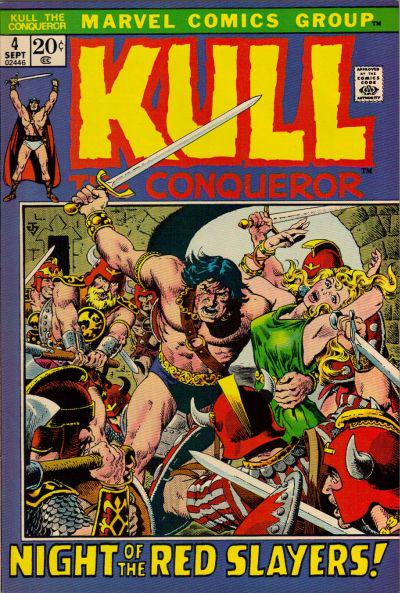
Kull the Conqueror #4
9.8
$1,199.00
9.6
—
9.4
—
RAW
$2.11
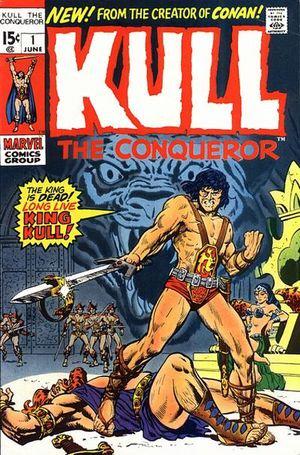
Kull the Conqueror #1
9.8
$528.00
9.6
—
9.4
—
RAW
$9.99
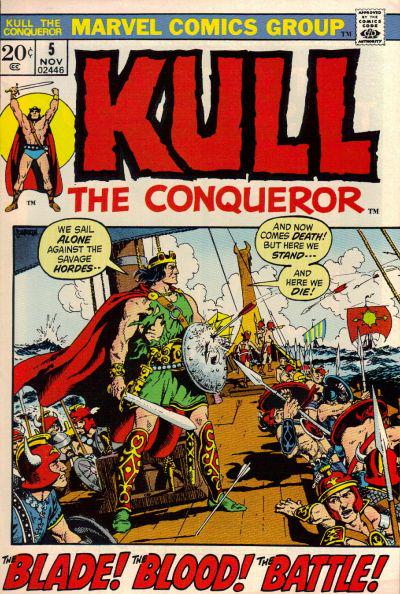
Kull the Conqueror #5
9.8
$294.95
9.6
—
9.4
—
RAW
$6.61
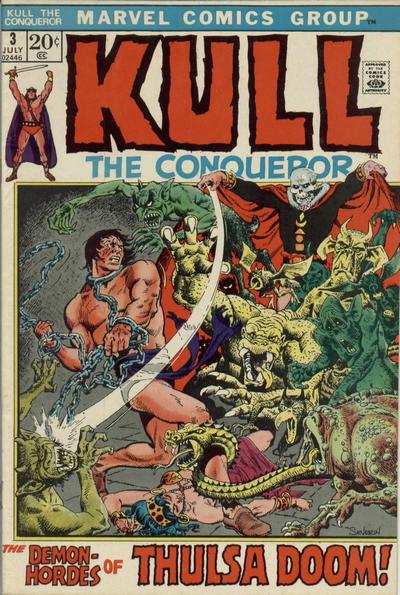
Kull the Conqueror #3
9.8
$291.53
9.6
—
9.4
—
RAW
$5.75
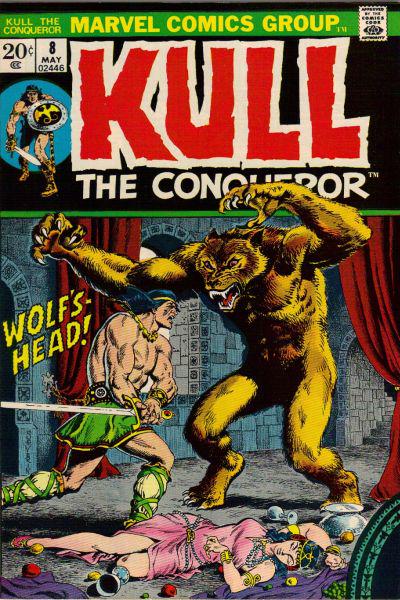
Kull the Conqueror #8
9.8
$212.49
9.6
—
9.4
—
RAW
$4.35
Kull on a black steed enters after conquering ancient decaying Valusia and then keeping it with a heavy hand. The crowd sees King Kull, and some whisper of his magnificent appearance and strong arms and shoulders, while others detract from him saying that he is from Atlantis. Ridondo sings a ballad to the troops passing by, and Alecto nearly decapitates the poet. Kull stays his sword and returns the lyre to him stating a poet is greater than a king, and that Kull did not fear mere words. Ridondo thanks Kull, but murmurs, in a low voice, that he will dance on King Kull’s grave and sing songs. A Pict from a foreign land, comes and bids entrance, but not laying down his spear, and despite the counselors advice, King Kull bids him in. He states “I AM BRULE-- CALLED THE SPEAR-SLAYER. KA-NU, AMBASSADOR OF OUR WESTERN ISLES SENDS GREETINGS AND SAYS-- A SEAT AWAITS KULL OF VALUSIA THIS NIGHT, AT THE FEAST OF THE RISING MOON." Kull senses a trap, and states that Picts are known to be liars, and Brûlée states that he could not raise his sword by commanded of his chief. Kull appears he’s going to chop his head off, but stops short, and states you are a brave Pict, and no liar. This causes a flashback in Kull’s mind, and he remembers his youth and how many thought the striped tigers be demons or gods. Kull was raised by them and differs in opinion. He could not , even speak the tongue of man but the tiger’s roar. The next day the young Kull sees a maiden about to be burned at the stake for mating with a Lemurian pirate. Kull kills the girl with a dagger and dives off a cliff escaping the arrows of the people wanting to burn the girl for sport. Kull is saved by the pirates only to serve as an oarsman till he escapes to be a gladiator and eventually a commander in the army of Valusia. He is then tricked by the same minstrel, Ridondo, as seen earlier into killing King Borna. Borna appears to get the best of Kull, but he slays the king with his dagger. Thus ends the origin of Kull. The spirit of the tiger appears at the end questioning his actions.
"The Thurian Chronicles" is a text article including the text "The Pre-Cataclysmic Age" by Robert E. Howard.
A map of Kull's primitive world of 20,000 years ago is in the works and will doubtless appear in issue #2 ("The Shadow Kingdom"), supplanting the less complete one in the Lancer paperback volume KING KULL. Meanwhile, as a basic framework for these tales, which precede by some 8000 years those of Conan the Cimmerian, we've taken the liberty of reprinting that portion of Howard's pseudo-historical piece "The Hyborian Age" — which tells virtually everything known, outside of a careful gleaning of the Kull tales themselves,-about that long-ago, legend-laden time and clime: THE PRE-CATACLYSMIC AGE by Robert E. Howard Of that epoch known by the Nemedian chroniclers as the Pre- Cataclysmic Age, little is known except the latter part, and that is veiled in the mists of legendry. Known history begins with the waning of the Pre-Cataclysmic civilization, dominated by the kingdoms of Kamelia, Valusia, Verulia, Grondar, Thule, and Commoria. These peoples spoke a similar language, arguing a common origin. There were other kingdoms, equally civilized, but inhabited by different, and apparently older, races. The barbarians of the age were the Picts, who lived on islands far out on the western ocean; the Atlanteans, who dwelt on a small continent between the Pictish Islands and the main, or Thurian, continent; and the Lemurians, who inhabited a chain of large islands in the eastern hemisphere. There were vast regions of unexplored land. The civilized kingdoms, though enormous in extent, occupied a comparatively small portion of the whole planet. Valusia was the westernmost kingdom of the Thurian Continent; Grondar the easternmost. East of Grondar, whose people were slightly less cultured than the other kingdoms, stretched a wild and barren expanse of deserts. Among the less arid stretches, in the jungles, and among the mountains, lived scattered clans and tribes of primitive savages. Far to the South there was a mysterious civilization, unconnected with the Thurian culture, and apparently pre-human in its nature. On the far eastern shores of the continent there lived another race, human, but mysterious and non-Thurian, with whom the Lemu- rians from time to time came in contact. They apparently came from a shadowy and nameless continent lying somewhere east of the Lemurian Islands. The Thurian civilization was crumbling; their armies were composed largely of barbarian mercenaries. Picts, Atlanteans, and Lemurians were their generals, their statesmen, often their kings. Of the bickerings of the kingdoms, and the wars between Valusia and Commoria, as well as the conquests by which the Atlanteans founded a kingdom on the mainland, there are more legends than accurate history.
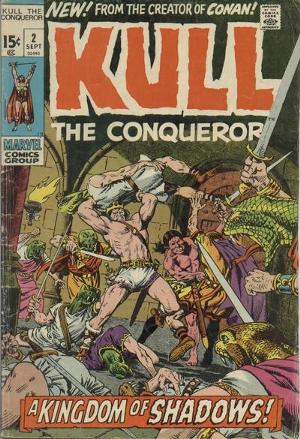
Cover art by Andru and Buscema, with substantial modifications by Severin. "A King Comes Riding" is based on the heroic tales of Robert E. Howard. "The Thurian Chronicles"'s text "The Pre-Cataclysmic Age" by Robert E. Howard was illustrated in "The Hyborian Age Chapter 1: The Pre-Cataclysmic Age", in Savage Sword of Conan Vol 1 7.