COMICBOOKSTOCKEXCHANGE.COM·
UTC LIVE TIMEDEAL RADAR
MARKET CLOCKS
HOME OFFICEHOME OFFICE--:--
NYSENew York--:--
LSELondon--:--
JPX / NIKKEITokyo--:--
DFM / ADXDubai--:--
WORLD / UTC--:--
Dynamite·Vampirella·#3·Bronze Age·ID-2405667
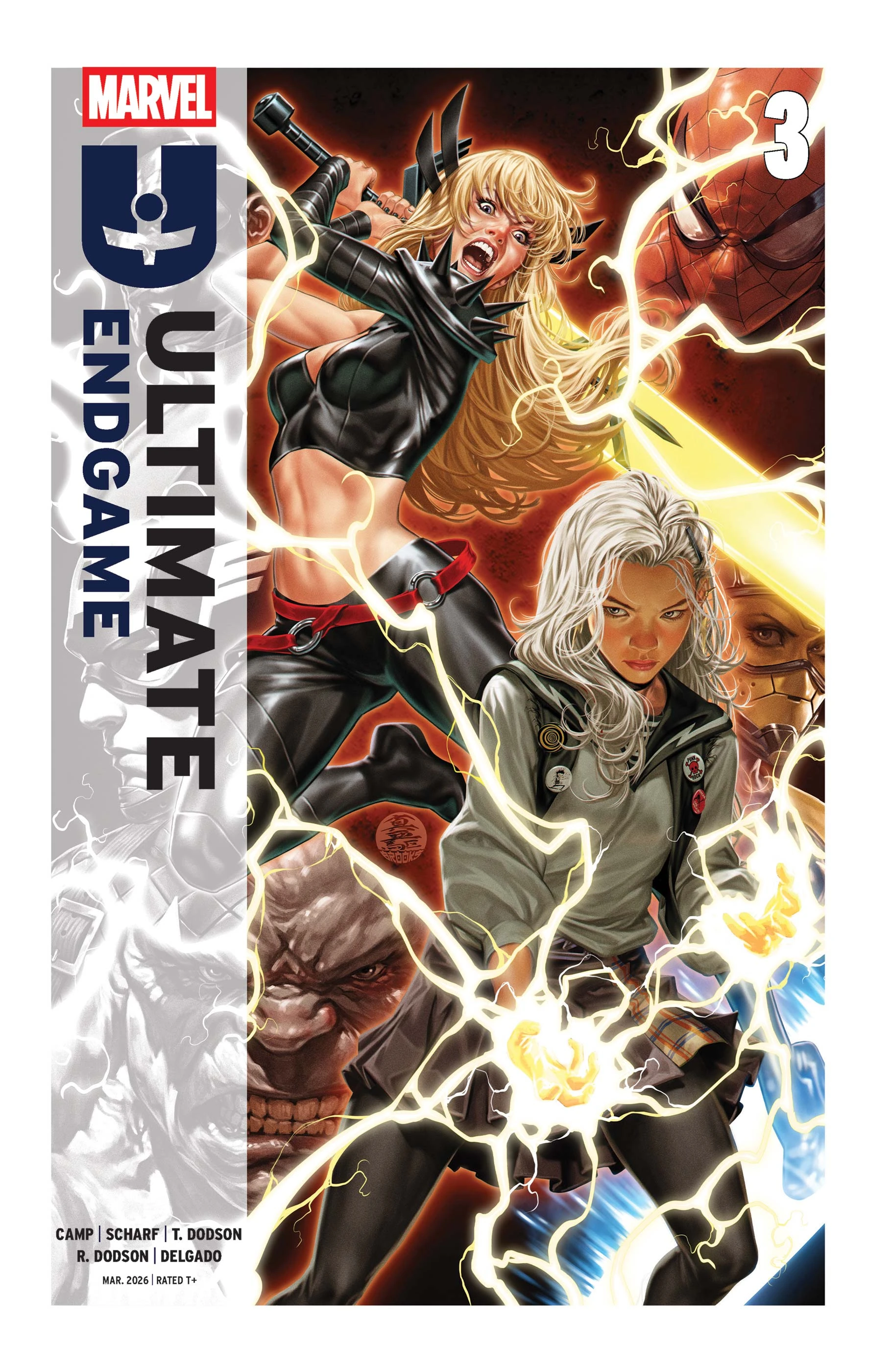 Variant #23247ACTIVE
Market operates purely on organic buyer and seller auction discovery. Zero artificial price interventions or emergency liquidity halts on record.
Understand how physical sales, invested dollars, and liquidity friction divide across grades.
Historical price records
Relative market value allocation
Estimated execution friction
Bibliographic provenance, creator credits, historical significance, and multimedia documentation.
No narrative synopsis recorded in GCD for this sequence.
Publisher profile coming soon
Comics grow darker and more socially aware. Wolverine, Punisher, Swamp Thing debut. Creator-driven storytelling emerges.
Newsstand variants carry meaningful scarcity premiums. First appearances from this era are blue-chip investments.
Bronze Age (1970–1984) — comics grew darker and more socially aware. The era of classic runs, creator-driven storytelling, and the birth of serious collecting culture. Newsstand variants carry a meaningful scarcity premium.
Inspectable mathematical proof, blockchain/ledger provenance, data integrity validation, and asset taxonomy.
In illiquid alternative asset markets, sovereign blue-chip holdings trade at an exponential multiple over mid-grade float due to institutional accumulation and inelastic seller reservation prices.
Each cover variant, retailer incentive, and subsequent printing represents an independent atomic tradeable instrument with unique supply elasticity, barcode registration, and secondary market demand.
Strict algorithmic segregation separating clean single-issue Cover A sales from multi-issue lot bundles, retailer exclusives, and foreign variants.

Vampirella #1
9.8
$550.00
9.6
—
9.4
—
RAW
$93.97
Vampirella #1
9.8
$323.04
9.6
—
9.4
—
RAW
$30.00
Vampirella #1
9.8
$299.00
9.6
—
9.4
—
RAW
$35.99
Vampirella #1
9.8
$250.00
9.6
—
9.4
—
RAW
$10.84

Vampirella #0
9.8
$199.99
9.6
—
9.4
—
RAW
$8.96
“Nature itself carries aloft the cries of my last born against so flagrant a summons no true mother can stand.”
— Lilith
Vampirella is jumping out of the Trantham window of the house that she thinks is a bargain piece of real estate located deep in the woods of a dark forest, bound to be haunted or a vampire Air B&B. She's been working for O.C.E.I. (Catholic Exorcism Initiative Office), a secret Jesuit sect, and was freelancing when they armed her with a wrist-mounted miniature crossbow device with which she was able to easily vanquish Nephilim in the guise of ash giants — automatons, mindless beings made up of compacted cremated human remains. The event had happened last year in Montpelier, Vermont.
She has recounted the details to her psychiatrist, who was trying to rationalize her story. Vampirella states the Marys were responsible for personally outfitting her with the crossbow device that actually launched phosphorus-tipped blades, and Vampirella described the Nephilim<ref>The Nephilim (/ˈnɛfɪˌlɪm/; Hebrew: נְפִילִים, romanized: Nəfīlīm) are enigmatic figures mentioned in several passages of the Hebrew Bible and later Jewish and Christian literature. They are traditionally associated with extraordinary size, strength, or status, though the biblical texts provide only brief and ambiguous descriptions. The earliest reference appears in Genesis 6:1–4, where the Nephilim are linked to the “mighty men of old” and to the controversial episode involving the “sons of God” and the “daughters of men”. Their identity, origin, and role in early biblical history have been the subject of extensive debate among scholars, theologians, and interpreters.[1]
The meaning of the term Nephilim is uncertain. Many translations render the word as “giants,” influenced by the Septuagint’s use of the Greek term gigantes, though this may reflect later interpretive traditions rather than the original Hebrew sense. Some scholars derive the term from the Hebrew root n-p-l (“to fall”), leading to interpretations such as “fallen ones” or “those who cause others to fall,” while others propose meanings related to violence, domination, or social oppression. Because the biblical text does not define the term explicitly, later Jewish and Christian writings played a major role in shaping the modern understanding of the Nephilim.
The Nephilim appear again in Numbers 13:33, where ten of the Twelve Spies report encountering formidable inhabitants in Canaan described as descendants of the Nephilim. This passage has contributed to the longstanding association of the Nephilim with great physical stature, though some scholars argue that the spies’ report may reflect exaggeration, fear, or rhetorical emphasis rather than literal description.[3]
Interpretations of the Nephilim vary widely across religious and academic traditions. One influential view, preserved in Second-Temple literature such as 1 Enoch and Jubilees, identifies the Nephilim as the offspring of rebellious angels (the Watchers) and human women, portraying them as destructive giants whose corruption contributed to the moral decline preceding the flood. Another major interpretation, found in some early Jewish and Christian commentaries, understands the Nephilim as powerful human rulers or warriors, possibly arising from intermarriage between the righteous line of Seth and the unrighteous line of Cain. A third approach views the Nephilim as legendary or symbolic figures reflecting ancient Near Eastern traditions about semi-divine heroes or primordial beings.[4]
Orthodox Judaism has taken a stance against the idea that Genesis 6 refers to angels or that angels could intermarry with men. Shimon bar Yochai pronounced a curse on anyone teaching this idea. Rashi and Nachmanides followed this.
Some individuals and groups, including St. Augustine, John Chrysostom, and John Calvin, take the view of Genesis 6:2 that the "Angels" who fathered the Nephilim referred to certain human males from the lineage of Seth, who were called sons of God probably in reference to their prior covenant with Yahweh (cf. Deuteronomy 14:1; 32:5); according to these sources, these men had begun to pursue bodily interests, and so took wives of "the daughters of men", e.g., those who were descended from Cain or from any people who did not worship God. [https://en.wikipedia.org/wiki/Nephilim Wiki]
</ref> about as dangerous as the Snoopy float in the Macy's parade, but she did mention they were very effective at scaring the crap out of locals. They were on a reconnaissance mission for a trailer-park child that was abducted. She then gets a little righteous, saying “you people just drunk and screwing without any thought of–” and then is interrupted by her Black psychiatrist questioning “you people..Blacks?” But she clarifies “humans,” which sets him at ease.
She then begins to theorize that Earth vampires could be genetic offshoots of the Vampiri, created by Mono Negative Virals, which she describes as viruses containing a negative-stranded non-segmented RNA genome. “Some might have been manufactured humans granted vampire-like abilities through a mutation of Erythropoietic protoporphyria.” She says you can never know whether they're originals or these genetic breeds till you're close enough to smell them.”
She further tells him that her sidearm had wooden bolts which should fire into the hearts of the vampires, but it looks like they might shoot all the way through, thus one might wonder if they really functioned like miniature stakes or not. After vanquishing the last vampire, she goes to the altar to pick up the child. The possessed child rips open his chest, causing the enzyme from the tendrils to paralyze her, even stopping her heart. Her wings cease functioning as she plummets to the ground, and she tells her psychiatrist that she could smell her — Lilith, her mother, who comes down to save her.
The psychiatrist clarifies “Mom?” Vampirella was telling her she did not need her help even though her heart had stopped. But her mother calls her Iubit, which means “beloved.” As she tells her that “Nature itself carries aloft the cries of my last born against so flagrant a summons no true mother can stand.” After her mother cuts off the tendrils of the paralytic organism, she tells her to stand up, but Vampirella says she can't, but her mother tells her she may have had a stroke “but you'll fully heal in a few hours.” She begins to talk about her life and her cooperating with religious zealots, further adding that half of them even want to kill her. She goes on further telling her that she has no existent social life and lovers that you can never seem to hold on to. And Vampirella realizes her mother's been spying on her, and Lilith says it's her prerogative. And then she mentions Eustankhios. The psychiatrist thinks it was a spider he had stepped on, but she says it's kind of like a version of Facebook for her mother; there's actually a Malagenii that takes on various animal forms.
Lilith accuses her of wanting redemption because she unleashed monsters on this world and that perhaps even Vampirella's creation by Lilith was the tool to vanquish the monsters. Then Vampirella likens it to trying to push the toothpaste back in the tube. Her mother tells her they both grapple with unyielding agony of regret and she came to tell her that she was “not trying to stifle her heart's ambition but rather to move you toward it.”
The psychiatrist was interested about the book that had been mentioned. Vampirella tells him it was the Book of Prophecies and in it it says that Lilith isn't really her mother. Then Vampirella states there's lots of contradicting versions as to where she came from and parallel realities and even mentions that her mother was human, the first female.<ref> In some Jewish folklore, such as the Alphabet of Sirach* (<abbr>c.</abbr> 700–1000 AD), Lilith appears as Adam's first wife, who was created at the same time and from the same clay as Adam. The legend of Lilith developed extensively during the Middle Ages, in the tradition of Aggadah, the Zohar, and Jewish mysticism. For example, in the 13th-century writings of Isaac ben Jacob ha-Cohen, Lilith left Adam after she refused to become subservient to him and then would not return to the Garden of Eden after she had coupled with the archangel Samael.
In Hebrew-language texts, the term lilith or lilit* (translated as "night creatures", "night monster", "night hag", or "screech owl") first occurs in a list of animals in Isaiah 34. The Isaiah 34:14 Lilith reference does not appear in most common Bible translations such as KJV and NIV. Commentators and interpreters often envision the figure of Lilith as a dangerous demon of the night, who is sexually wanton, and who steals babies in the darkness. Currently there is no scholarly consensus, with some adhering to the animalistic interpretation, whereas others claim 34:14 is referencing a literal demon or a category of demons falling under the specification of "lilith". Historically, certain prominent Jewish rabbis in Talmudic texts feared the likes of liliths, some to such an extent that they recommended men not sleep in a home alone, as any who do would be "seized by Lilith." Jewish incantation bowls and amulets from Mesopotamia from the first to the eighth centuries identify Lilith as a female demon and provide the first visual depictions of her. The said amulets were often symbolic divorce papers, warding off a given lilith that was thought to be haunting one's house or family. [https://en.wikipedia.org/wiki/Lilith Wiki]
</ref> Her mother is standing next to the psychiatrist questioning why are we talking to this insect, and he tells her “nobody invited you, Devil wears Prada<ref>The Devil Wears Prada (2006) is a beloved comedy-drama starring Meryl Streep as ruthless fashion editor Miranda Priestly and Anne Hathaway as her assistant, Andy Sachs. Based on a 2003 novel, the film features Emily Blunt and Stanley Tucci. A 2026 sequel, The Devil Wears Prada 2, reunites the main cast as Miranda navigates the industry's evolution against a now-senior Emily. [https://en.wikipedia.org/wiki/The_Devil_Wears_Prada_(film), https://www.imdb.com/title/tt0458352/<nowiki>]</nowiki></ref>.” Lilith then tells him you're having a heart attack and Vampirella calls her a child as the psychiatrist clutches his chest. He continues to try and rationalize it and Lilith says only human arrogance dismisses the supernatural, calling him Doc Chary. She further adds that the Vampiri can influence weaker minds and that his chest pain would soon stop.
The psychiatrist tells her there is no Devil and Lilith tells him I'll be sure and tell him you said so and further tries to explain some details of the realm from which she comes from and how beautiful it was. But Vampirella breaks in, telling her it was a dying world with extreme drought and actually caused by Lilith's attempt to conquer it.
Lilith retorts back telling her “All of which is a result of you choosing a human life over your own .. A termite playing games with the fabric of creation …” It began with a maintenance technician inspecting a collider who had been accidentally transported to another realm, Draculon. She recognized that he was dying without water and could not drink the Blood Rivers of Draculon, so she strapped him into his machine and eventually transported herself to Earth with him as well.
Vampirella describes the Earth as the world teeming with human cattle and perhaps an army to enslave Earth as a blood donor bank. The psychiatrist then finishes remarking “now you're trapped here hunting your own kind.” Vampirella clarifies that she's actually an extraterrestrial and that the vampires have certain limits like sunlight and crucifixes and garlic. Perhaps even paprika strikes terror in their hearts. Lilith says that the Book of Prophecy suggested that she made it with a variety of demons which became the origin of vampires on Earth and she attributes it to drinking heavily in those days. And the psychiatrist then looks at Vampirella saying they're your sisters and brothers so you're running around committing fratricide.
Vampirella tells the psychiatrist that Lilith conceived her in the first place because she goes on binges where she conquers and kills then does an about-face and puts on a white hat to do good. She describes herself as being a product of Lilith's remorse like some sort of 12-step program. The psychiatrist insightfully states he understands why “Ella needs a mother.” And looking at Lilith states “what I'm curious about, Lilith … why do you need a daughter? You have lots of children … What's missing in your life … that you insist on following her?” Lilith pauses though then responds “nice try.”
Lilith states “I vote we kill him.” The psychiatrist theorizes maybe they share some sort of extra-sensory potentiality that contributes to their trauma-induced psychosis but it doesn't answer the larger question “what are you doing? Why are you doing it? And most important, what do you want?”
Back at Montpelier, VT last year, a man in a flannel shirt approaches a nun who tells him to take off his shoes as they were standing on consecrated ground — the ash stolen cremated remains of those departed — and they sprinkled holy water across the remains. He calls Mother Mary “Penguin” as she holds a crucifix in her left hand and a deer rifle with scope in her right. As he pulls his sidearm to fire, she shoots off the top portion of his calvarium and then the crucifix is in her right hand and the gun in her left. This event is shortly after the rescue of the child. Mary Cleopas states that Vampirella is one of them (vampires) but Mother Mary states she is one of us.