COMICBOOKSTOCKEXCHANGE.COM·
UTC LIVE TIMEDEAL RADAR
MARKET CLOCKS
HOME OFFICEHOME OFFICE--:--
NYSENew York--:--
LSELondon--:--
JPX / NIKKEITokyo--:--
DFM / ADXDubai--:--
WORLD / UTC--:--
DC·Green Lantern·#7·Silver Age·ID-2355469
| Grade | Census & Float Distribution | Role | FMV | Total Value | Multiple |
|---|---|---|---|---|---|
| 9.6 | 2 of 1,181 slabs (0.2%) | — | — | — | |
| 9.4 | 5 of 1,181 slabs (0.4%) | — | — | — | |
| 9.2 | 10 of 1,181 slabs (0.8%) | SOV | $6,073.61 | $60,736.10 | (17.2x) |
| 9.0 | 13 of 1,181 slabs (1.1%) | $2,880.00 | $37,440.00 | (8.2x) | |
| 5.0 | 125 of 1,181 slabs (10.6%) | ANC | $650.00 | $81,250.00 | (1.8x) |
| RAW | 258,819 ungraded (260,000 printed − 1,181 graded) | RAW | $352.50 | $91,233,697.50 | (1.0x Base) |
Assumes raw copies grade like the copies already in the CGC census (which skews to copies owners chose to submit). Fees: CGC Vintage tier by graded value ($30–$105, 4% above $1,000), insured shipping shared across 10 books; pre-screen reject $14; eBay 13.25%. Not financial advice.
Underlying: CGC 5.0 (Liquid Center) · Spot $650.00 · Model IV 37.2% · Open Contracts: 0
| Calls (Right to Buy 1 Copy) | Strike | Puts (Right to Sell 1 Copy) | ||||||||
|---|---|---|---|---|---|---|---|---|---|---|
| OCC Contract | Premium | Intr / Time | IV · Δ | Θ/d · ν | Strike $ | OCC Contract | Premium | Intr / Time | IV · Δ | Θ/d · ν |
| GL7-261218C520 | $131.53 | $130.00 + $1.53 | 42.4% · 0.98 | -0.11 · 0.06 | $520.00 | GL7-261218P520 | $0.38 | $0.00 + $0.38 | 42.4% · -0.02 | -0.06 · 0.06 |
| GL7-261218C590 | $66.19 | $60.00 + $6.19 | 38.9% · 0.86 | -0.36 · 0.37 | $590.00 | GL7-261218P590 | $4.89 | $0.00 + $4.89 | 38.9% · -0.14 | -0.30 · 0.37 |
| GL7-261218C620 | $42.94 | $30.00 + $12.94 | 37.9% · 0.71 | -0.50 · 0.55 | $620.00 | GL7-261218P620 | $11.57 | $0.00 + $11.57 | 37.9% · -0.29 | -0.44 · 0.55 |
| GL7-261218C650 | $24.90 | $0.00 + $24.90 | 37.2% · 0.53 | -0.56 · 0.65 | $650.00ATM | GL7-261218P650 | $23.47 | $0.00 + $23.47 | 37.2% · -0.47 | -0.49 · 0.65 |
| GL7-261218C680 | $12.75 | $0.00 + $12.75 | 36.7% · 0.34 | -0.50 · 0.60 | $680.00 | GL7-261218P680 | $41.25 | $30.00 + $11.25 | 36.7% · -0.66 | -0.43 · 0.60 |
| GL7-261218C720 | $4.29 | $0.00 + $4.29 | 36.3% · 0.15 | -0.30 · 0.37 | $720.00 | GL7-261218P720 | $72.71 | $70.00 + $2.71 | 36.3% · -0.85 | -0.24 · 0.37 |
| GL7-261218C780 | $0.58 | $0.00 + $0.58 | 36.3% · 0.03 | -0.08 · 0.10 | $780.00 | GL7-261218P780 | $130.00 | $130.00 + $0.00 | 36.3% · -0.97 | -0.01 · 0.10 |
Empirical cash settlement intelligence, cross-grade elasticity curve, and secondary liquidation velocity.
Empirical step multipliers between adjacent condition tiers. Pinpoints the exponential premium transition and capital efficiency frontier.
Realized turnover cadence and capital absorption depth across certified auction comps.
Autonomous institutional strategies, financial equilibrium, scarcity modeling, and algorithmic risk profiling.
Market operates purely on organic buyer and seller auction discovery. Zero artificial price interventions or emergency liquidity halts on record.
Verified historical transaction line with quarterly equilibrium baseline anchor.
Understand how physical sales, invested dollars, and liquidity friction divide across grades.
Completed market sales by grade
Relative market value allocation
Estimated execution friction
Bibliographic provenance, creator credits, historical significance, and multimedia documentation.
John Broome
Gil Kane
Joe Giella
Gaspar Saladino
Julius Schwartz
Home of Superman, Batman, Wonder Woman, and the Justice League.
Marvel revolution. Stan Lee, Jack Kirby, and Steve Ditko create the modern superhero. Spider-Man, Fantastic Four, X-Men debut.
The sweet spot for collectors — significant enough to be culturally important, scarce enough to be valuable. 9.8 copies are extremely rare.
Silver Age (1956–1970) — the era that redefined the superhero genre. Scientific themes, moral complexity, and Stan Lee's Marvel revolution define this period. High-grade copies command aggressive premiums.
Inspectable mathematical proof, blockchain/ledger provenance, data integrity validation, and asset taxonomy.
In illiquid alternative asset markets, sovereign blue-chip holdings trade at an exponential multiple over mid-grade float due to institutional accumulation and inelastic seller reservation prices.
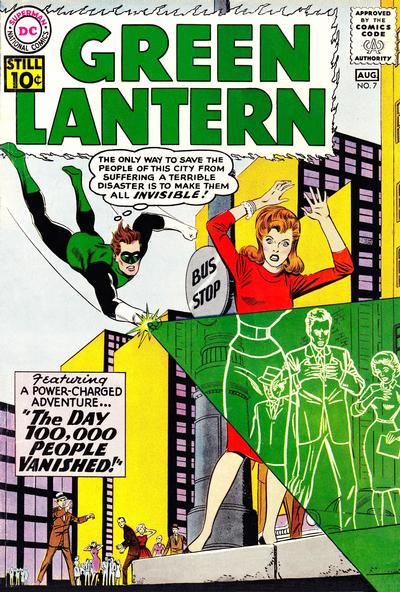
When the entire population of Valdale suddenly vanishes, Green Lantern's astral form is summoned by the Guardians of the Universe. The Guardians tell him of Sinestro, an alien they chose to be the Green Lantern of Korugar. However, Sinestro abused his powers and used them to enslave his planet and install himself as dictator. As punishment, the Guardians stripped Sinestro of his powers and banished him to Qward in the Antimatter Universe. They then warn that Sinestro has formed an alliance with the Weaponers of Qward to finally defeat the Green Lantern, by potentially exploiting his vulnerability when his power ring's 24 hour charge runs out. Part of the plan was to transport people from Valdale to Qward in a sweeping attempt to capture Green Lantern, who was scheduled to be in that town. Having his mind returned to his body (this time, allowing Green Lantern to remember his encounter) Hal flies to the next city which is targeted by Sinestro. In order to prevent the people there from being transported to Qward, Green Lantern makes them all invisible, and only he is transported to Qward. There he battles the Qwardian Weaponers, however surrenders when Sinestro promises to return the people of Valedale to Earth. In doing so, Green Lantern is incased in a yellow bubble, and Sinestro and the Qwardians time the moments left in the power ring's charge. However, when they release Green Lantern they are shocked to find he still has power in his ring and is able to defeat them all. He reveals to Sinestro that he had found a tiny hole in the yellow bubble he was trapped in and used his power ring to fire compressed air at the clock they were watching to make it reach the 24 hour mark faster so that they would think that his ring ran out of power when it still had some time left. He then imprisons Sinestro in a force bubble of his own before returning to Earth and appearing at an opening of a Boys Settlement House in Valedale.
Each cover variant, retailer incentive, and subsequent printing represents an independent atomic tradeable instrument with unique supply elasticity, barcode registration, and secondary market demand.
Strict algorithmic segregation separating clean single-issue Cover A sales from multi-issue lot bundles, retailer exclusives, and foreign variants.
Green Lantern #1
9.4
$50,787.50
9.6
—
9.4
$50,787.50
RAW
$609.00
Green Lantern #59
9.8
$13,511.76
9.6
$2,684.00
9.4
$1,805.02
RAW
$191.62

Green Lantern #16
9.6
$12,810.00
9.6
$12,810.00
9.4
$6,405.00
RAW
$144.20
Green Lantern #76
9.8
$12,256.68
9.6
$11,400.00
9.4
$2,614.00
RAW
$236.63

Green Lantern #21
9.8
$6,900.00
9.6
$2,318.00
9.4
$1,140.01
RAW
$35.21
In an attempt to capture Green Lantern, Sinestro captures 100,000 people from the town of Valdale. The Guardians warn Green Lantern of Sinestro's plan and Green Lantern travels to Qward to rescue the citizens of Valdale.
Green Lantern accidentally changes Pieface into a bird while Green Lantern is having a dream. Later Green Lantern has to meet Terga at the airport and stop a hijacking.
“| Speaker =”
— | StoryTitle1 = The Wizard of Odds!
In the year 3042 a scientist named Raakj is turned down for an important position he'd been hoping to get because his methods are too uncontrolled. Raakj sees a historical film and hits on the idea of going back in time and betting on sporting events and suchlike to make his fortune with the knowledge he has of events from the future, so he and his sweetheart can have a comfortable life after missing out on his dream promotion. Raakj builds a time machine but within minutes of traveling back to the 40's, he's hit by a car and taken to a hospital by Green Lantern. Fearing the hero's interference in his plan, Raakj flees the hospital as quickly as he can. He makes a fortune with his gambling plan, but is kidnapped by Nutsy Hagan, a gangster obsessed with eating walnuts. Hagan forces Raakj to use his foreknowledge to gamble on his behalf, and the headlines from Hagan's run of luck catch Green Lantern's attention. Hagan's underlings knock Green Lantern out with a wooden chair, but Raakj turns on Hagan and reveals his true story to the prisoners, before leaving them to suffocate from a poison gas pellet. Green Lantern manages to cut his ropes and break a window to let in fresh air, but by then Raakj is gone. The man from the future is also furious as he realizes that the money he's made will be worthless when he travels back to his own time.
Raakj decides, instead of printed currency from a bygone age, what he could do is find something more timeless like a supply of a valuable element like radium. To find it somewhere no-one else can go, he decides to look on the moon. Meanwhile Alan Scott's discharged from the army: his training with radio makes him far more valuable there than as just another soldier. Doiby feigns weakness to be discharged to so he isn't split up from his partner. Word reaches Nutsy Hagan that Raakj has been working on a dirigible, and Doiby eavesdrops and passes the gang's plan to kill Raakj for betraying them on to Green Lantern. What both groups find out is Raakj wasn't building a dirigible, but a rocketship, and flies to the moon with all of them along for the ride. Raakj drills down into a crater that turns out to hide an underground city inhabited by "Selenites" who are being attacked by ape-people who ride huge birds. Green Lantern fends them off and the group's greeted by the peaceful Selenites. The ape-men kidnap the king's son and Doiby, and Green Lantern goes after them. However it's been more than twenty-hours since he charged the ring and he becomes easy prey for capture himself.
Alan Scott's short stint in the Army is terminated in this issue. Pvt. Alan Scott is honorably discharged to become a radio troubleshooter for the homeland. MSG Charles "Doiby" Dickles feigns weakness & agedness to get discharged himself to stay with his best friend, the Green Lantern.
Green Lantern fights in an arena against alien monsters but manages to capture the ape-man king and force him to release the prisoners and show GL where their bird-steeds are kept. The king attacks the Selenites' city in a giant robot, but Green Lantern scales it and manages to knock the king from the cockpit in its head then controls the robot into destroying itself. A peace treaty's negotiated between the two settlements when it turns out all the ape-men wanted was access to more water. As a reward for his service the king of the Selenites rewards Green Lantern with a hypnotic moonstone, which Raakj steals uses to force Green Lantern to reveal the ring's source of power. Raakj tries to escape the moon with both power items, but the Selenites combine their telepathic powers to try to compel Raakj to bring them back.
A mental battle rages but eventually the Selenites overpower Raakj. When he comes to return the power items, Nutsy Hagan takes command of them. He agrees to take Green Lantern and Doiby back to Earth because he owes the hero for saving him from the gas attack before. Once they land Doiby reveals he surreptitiously stole the lamp back, letting Green Lantern regain his powers. They chase down Nutsy and recapture the hypnotic moonstone, but then Raakj steals it from them and travels back to his own time. Green Lantern asks his lantern to transport him to the future to stop Raakj from abusing the moonstone's power, and it agrees to do so. In the future they get the address of Raakj's girlfriend Dorna and get a ride to her place in the taxi of Doiby's descendant, Homberg Dickles. Dorna rejects Raakj's insane dreams of power, and while he and Green Lantern duel she falls off a walkway but the emerald crusader saves her. This almost-loss opens Raakj's eyes and he gives up his dreams of conquest and hands back the moonstone. Back in their own time, the only thing Doiby can think about from their adventure to the future is his hat being called stupid by a member of his own family.