COMICBOOKSTOCKEXCHANGE.COM·
UTC LIVE TIMEDEAL RADAR
MARKET CLOCKS
HOME OFFICEHOME OFFICE--:--
NYSENew York--:--
LSELondon--:--
JPX / NIKKEITokyo--:--
DFM / ADXDubai--:--
WORLD / UTC--:--
DC·Green Lantern·#11·Silver Age·ID-2355371
| Grade | Census & Float Distribution | Role | FMV | Total Value | Multiple |
|---|---|---|---|---|---|
| 9.8 | 2 of 254 slabs (0.8%) | SOV | $6,297.70 | $12,595.40 | (166.8x) |
| 9.6 | 3 of 254 slabs (1.2%) | — | — | — | |
| 9.4 | 8 of 254 slabs (3.1%) | $657.25 | $5,258.00 | (17.4x) | |
| 9.2 | 12 of 254 slabs (4.7%) | $617.48 | $7,409.76 | (16.4x) | |
| 9.0 | 22 of 254 slabs (8.7%) | $373.83 | $8,224.26 | (9.9x) | |
| 8.0 | 23 of 254 slabs (9.1%) | ANC | $255.38 | $5,873.74 | (6.8x) |
| RAW | 249,746 ungraded (250,000 printed − 254 graded) | RAW | $37.75 | $9,427,911.50 | (1.0x Base) |
Assumes raw copies grade like the copies already in the CGC census (which skews to copies owners chose to submit). Fees: CGC Vintage tier by graded value ($30–$105, 4% above $1,000), insured shipping shared across 10 books; pre-screen reject $14; eBay 13.25%. Not financial advice.
Underlying: CGC 8.0 (Liquid Center) · Spot $255.38 · Model IV 37.0% · Open Contracts: 0
| Calls (Right to Buy 1 Copy) | Strike | Puts (Right to Sell 1 Copy) | ||||||||
|---|---|---|---|---|---|---|---|---|---|---|
| OCC Contract | Premium | Intr / Time | IV · Δ | Θ/d · ν | Strike $ | OCC Contract | Premium | Intr / Time | IV · Δ | Θ/d · ν |
| GL11-261218C200 | $55.92 | $55.38 + $0.54 | 43.1% · 0.99 | -0.03 · 0.02 | $200.00 | GL11-261218P200 | $0.10 | $0.00 + $0.10 | 43.1% · -0.01 | -0.02 · 0.02 |
| GL11-261218C230 | $27.55 | $25.38 + $2.17 | 39.1% · 0.87 | -0.13 · 0.13 | $230.00 | GL11-261218P230 | $1.66 | $0.00 + $1.66 | 39.1% · -0.13 | -0.11 · 0.13 |
| GL11-261218C240 | $19.46 | $15.38 + $4.08 | 38.2% · 0.76 | -0.18 · 0.20 | $240.00 | GL11-261218P240 | $3.56 | $0.00 + $3.56 | 38.2% · -0.24 | -0.16 · 0.20 |
| GL11-261218C260 | $7.64 | $0.00 + $7.64 | 37.0% · 0.45 | -0.21 · 0.25 | $260.00ATM | GL11-261218P260 | $11.69 | $4.62 + $7.07 | 37.0% · -0.55 | -0.19 · 0.25 |
| GL11-261218C270 | $4.18 | $0.00 + $4.18 | 36.6% · 0.30 | -0.18 · 0.22 | $270.00 | GL11-261218P270 | $18.21 | $14.62 + $3.59 | 36.6% · -0.70 | -0.16 · 0.22 |
| GL11-261218C280 | $2.09 | $0.00 + $2.09 | 36.4% · 0.17 | -0.13 · 0.16 | $280.00 | GL11-261218P280 | $26.10 | $24.62 + $1.48 | 36.4% · -0.83 | -0.11 · 0.16 |
| GL11-261218C310 | $0.17 | $0.00 + $0.17 | 36.3% · 0.02 | -0.02 · 0.03 | $310.00 | GL11-261218P310 | $54.62 | $54.62 + $0.00 | 36.3% · -0.98 | 0.00 · 0.03 |
Empirical cash settlement intelligence, cross-grade elasticity curve, and secondary liquidation velocity.
Empirical step multipliers between adjacent condition tiers. Pinpoints the exponential premium transition and capital efficiency frontier.
Realized turnover cadence and capital absorption depth across certified auction comps.
Autonomous institutional strategies, financial equilibrium, scarcity modeling, and algorithmic risk profiling.
Market operates purely on organic buyer and seller auction discovery. Zero artificial price interventions or emergency liquidity halts on record.
Verified historical transaction line with quarterly equilibrium baseline anchor.
Understand how physical sales, invested dollars, and liquidity friction divide across grades.
Completed market sales by grade
Relative market value allocation
Estimated execution friction
Bibliographic provenance, creator credits, historical significance, and multimedia documentation.
John Broome
Gil Kane
Joe Giella
Gaspar Saladino
Julius Schwartz
Home of Superman, Batman, Wonder Woman, and the Justice League.
Marvel revolution. Stan Lee, Jack Kirby, and Steve Ditko create the modern superhero. Spider-Man, Fantastic Four, X-Men debut.
The sweet spot for collectors — significant enough to be culturally important, scarce enough to be valuable. 9.8 copies are extremely rare.
Silver Age (1956–1970) — the era that redefined the superhero genre. Scientific themes, moral complexity, and Stan Lee's Marvel revolution define this period. High-grade copies command aggressive premiums.
Inspectable mathematical proof, blockchain/ledger provenance, data integrity validation, and asset taxonomy.
In illiquid alternative asset markets, sovereign blue-chip holdings trade at an exponential multiple over mid-grade float due to institutional accumulation and inelastic seller reservation prices.
After a series of uncharacteristic episodes in which Green Lantern had almost committed various crimes, he is brought before his fellow Green Lanterns for sentencing. The court of his peers is told of each incident: How Hal entered a bank, used his power ring to stun the tellers but left without taking any money; Hal almost bullied himself into not paying a $100 entry fee for a gallery; and finally how he procrastinated in saving a young man who had fallen out of a window. Deciding not to punish Hal because he had not actually done anything illegal, Hal demands that the other Green Lanterns punish him because he feels he has lost control. Putting it to a vote, they agree to do so, devest Hal of his Green Lantern emblem and power ring, seal him in a capsule and launch it into space. While traveling through the void, the capsule is suddenly transported to the Antimater Universe and to the planet Qward, where Hal is brought before Sinestro. Sinestro explains that he escaped his imprisonment in his last encounter because he had a spare power ring hidden in the heel of his boot and manage to escape to Qward to plan a new revenge against the Green Lantern. He then explains he used a device to alter Green Lantern's personality so that he became selfish but couldn't push him into doing anything illegal. Suddenly the other Green Lanterns arrive to save Hal, having suspected Sinestro's involvement they played into his hands. However, Sinestro traps them all in a room made of yellow material. Giving Hal back his power ring, he comes up with an idea of using it to pull chemicals out of the air and make an acid strong enough to melt through the walls. Freeing themselves, they easily capture Sinestro and subject him to his own machine. Imprisoning him with the device which would tell him over and over that he cannot escape.
Strict algorithmic segregation separating clean single-issue Cover A sales from multi-issue lot bundles, retailer exclusives, and foreign variants.
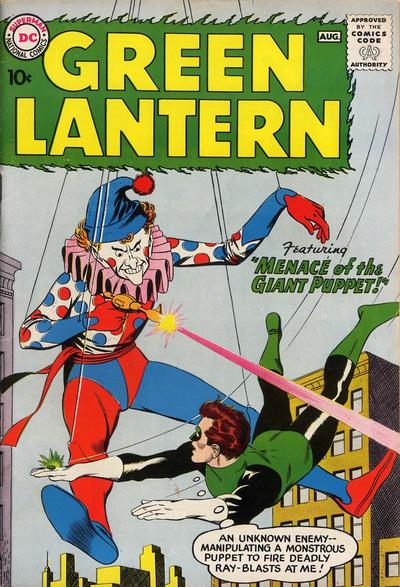
Green Lantern #1
9.4
$50,787.50
9.6
—
9.4
$50,787.50
RAW
$609.00
Green Lantern #59
9.8
$13,511.76
9.6
$2,684.00
9.4
$1,805.02
RAW
$191.62

Green Lantern #16
9.6
$12,810.00
9.6
$12,810.00
9.4
$6,405.00
RAW
$144.20
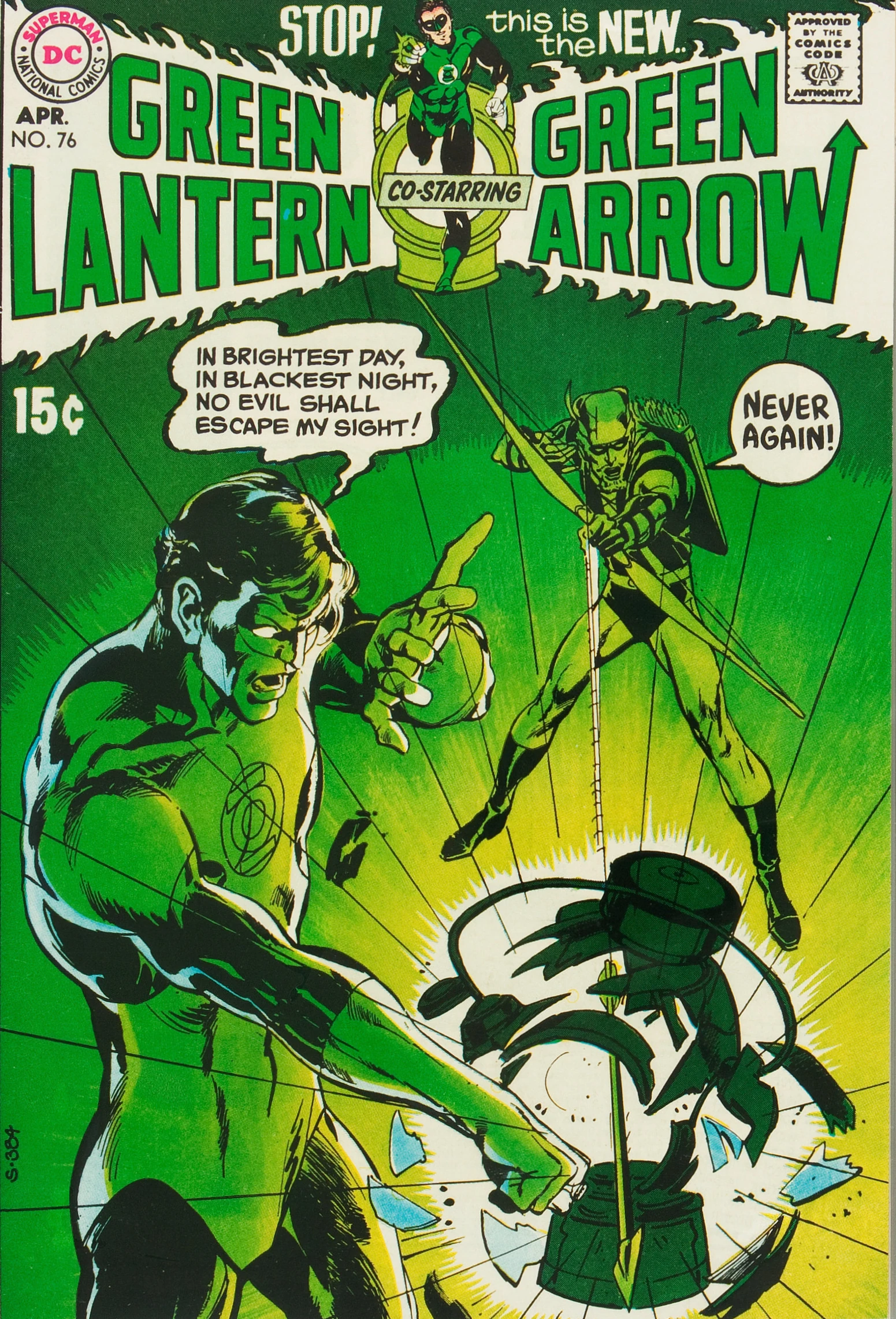
Green Lantern #76
9.8
$12,256.68
9.6
$11,400.00
9.4
$2,614.00
RAW
$236.63

Green Lantern #21
9.8
$6,900.00
9.6
$2,318.00
9.4
$1,140.01
RAW
$35.21
Sinestro tries to mind control Hal Jordan. Hal's behaviour gets him called before the Green Lantern Corps.
Hal Jordan loses his power ring and it's found by a child.
As a promotional gimmick, the Inca Insurance company offers Doiby a free life insurance policy worth $1,000. Except the guy who drew up the policy accidentally added a few more zeroes, and the payout is actually for $1,000,000. Not realizing this, Doiby decides to leave the money to some down-on-their-luck friends of his. Seeing how much they stand to make, thoughts of arranging an "accident" quickly appear in their minds.
His problems are soon even worse, as a group of thugs show up and demand Doiby hand the policy over to them. He drives home and sends a secret signal to Alan Scott, who switches to Green Lantern and comes down to help knock some sense into the crooks. In the ensuing fight, Doiby carelessly punches one hood into a wooden rocking chair that rocks back and hits Green Lantern on the head. After recovering, GL trails them to a hotel room they're using as a hideout, but after another brawl a drop-down bed comes out of the wall and hits GL insensate. The thugs explain themselves to the hero: the guy who over-wrote Doiby's policy was fired for the mistake, but told his tale to a rival insurance firm. The thugs were hired to kill Doiby so that Inca Insurance would be bankrupted by the enormous payout.
Doiby makes it into the room and unties Green Lantern, who reveals he put luminescent paint on the crooks' car to be able to follow them. GL brings some stoves to life to menace the crooks into submission. Meanwhile, having had enough of fighting off hired killers and his own supposed friends trying to collect on his death, Doiby tears up the policy.
| Trivia = Beginning in the previous issue, wood is depicted as the only weakness of Green Lantern. In this issue he is struck by a wooden rocking chair and a folding bed. Before that, any nonmetallic objects could hurt the hero, not only wood.