COMICBOOKSTOCKEXCHANGE.COM·
UTC LIVE TIMEDEAL RADAR
MARKET CLOCKS
HOME OFFICEHOME OFFICE--:--
NYSENew York--:--
LSELondon--:--
JPX / NIKKEITokyo--:--
DFM / ADXDubai--:--
WORLD / UTC--:--
Safeguard Promotional
DC·Action Comics·#1·Bronze Age·ID-3314146
| Grade | Census & Float Distribution | Copies / Slabs | Role | FMV | Sales | Total Value | Multiple |
|---|---|---|---|---|---|---|---|
| 9.8 | 359 of 647 slabs (55.5%) | 359 | ANC | $158.75 | 31 | $56,991 | (7.9x) |
| 9.6 | 166 of 647 slabs (25.7%) | 166 | $227.00 | — | $37,682 | (11.4x) | |
| 9.4 | 57 of 647 slabs (8.8%) | 57 | $139.98 | 2 | $7,979 | (7.0x) | |
| 9.2 | 28 of 647 slabs (4.3%) | 28 | $116.99 | 1 | $3,276 | (5.9x) | |
| 9.0 | 20 of 647 slabs (3.1%) | 20 | — | — | — | (3.1%) | |
| RAW | Raw Uncertified Copies | — | RAW | $19.99 | 1 | — | (1.0x Base) |
Empirical cash settlement intelligence, cross-grade elasticity curve, and secondary liquidation velocity.
Empirical step multipliers between adjacent condition tiers. Pinpoints the exponential premium transition and capital efficiency frontier.
Realized turnover cadence and capital absorption depth across certified auction comps.
Autonomous institutional strategies, financial equilibrium, scarcity modeling, and algorithmic risk profiling.
Market operates purely on organic buyer and seller auction discovery. Zero artificial price interventions or emergency liquidity halts on record.
Verified historical transaction line with quarterly equilibrium baseline anchor.
Understand how physical sales, invested dollars, and liquidity friction divide across grades.
Completed market sales by grade
Relative market value allocation
Estimated execution friction
Bibliographic provenance, creator credits, historical significance, and multimedia documentation.
? (ad copy)
? (see notes)
? (see notes)
typeset; ? (logo design, see notes)
Home of Superman, Batman, Wonder Woman, and the Justice League.
Comics grow darker and more socially aware. Wolverine, Punisher, Swamp Thing debut. Creator-driven storytelling emerges.
Newsstand variants carry meaningful scarcity premiums. First appearances from this era are blue-chip investments.

Bronze Age (1970–1984) — comics grew darker and more socially aware. The era of classic runs, creator-driven storytelling, and the birth of serious collecting culture. Newsstand variants carry a meaningful scarcity premium.
Inspectable mathematical proof, blockchain/ledger provenance, data integrity validation, and asset taxonomy.
A pricing discrepancy between an auction listing and the prevailing cleared consensus value across organized exchanges, allowing rapid liquidity capture before market equilibrium reconverges.
Superman delivers a witness to the governor to stop an execution, then stops a wife-beater. Later Superman, as Clark Kent, goes out with Lois, but she earns the wrath of Butch Matson and Superman must save her. Finally, Clark is assigned a story on the South American republic of San Monte. He heads to Washington DC to find out who is behind Senator Barrows pushing legislation which will embroil the United States in a war in Europe by grabbing lobbyist Alex Greer and scaring the truth out of him.
Strict algorithmic segregation separating clean single-issue "Safeguard Promotional" sales from multi-issue lot bundles, retailer exclusives, and foreign variants.
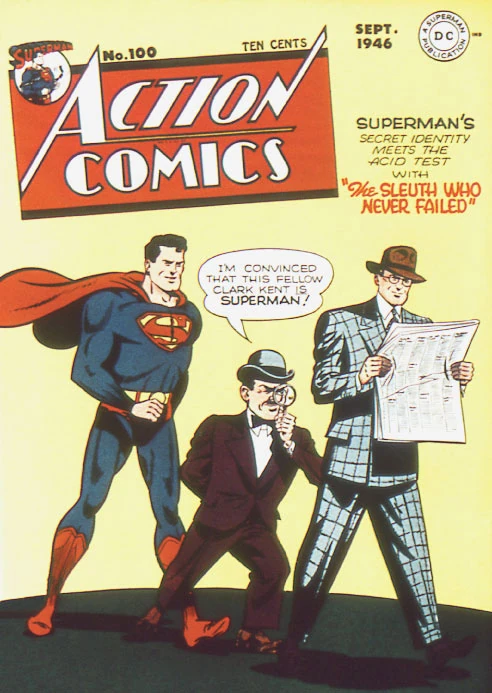
Action Comics #100
9.8
$12,000.00
9.6
—
9.4
—
RAW
$289.00
Action Comics #1
9.8
$380.00
9.6
—
9.4
—
RAW
$25.00
Action Comics #1
9.8
$335.00
9.6
—
9.4
—
RAW
$407.55
Action Comics #1
9.8
$267.28
9.6
—
9.4
—
RAW
$23.81
Action Comics #1
9.8
$255.68
9.6
—
9.4
—
RAW
$24.00
“A physical marvel, a mental wonder, **Superman** is destined to reshape the destiny of a world!”
— Narrator
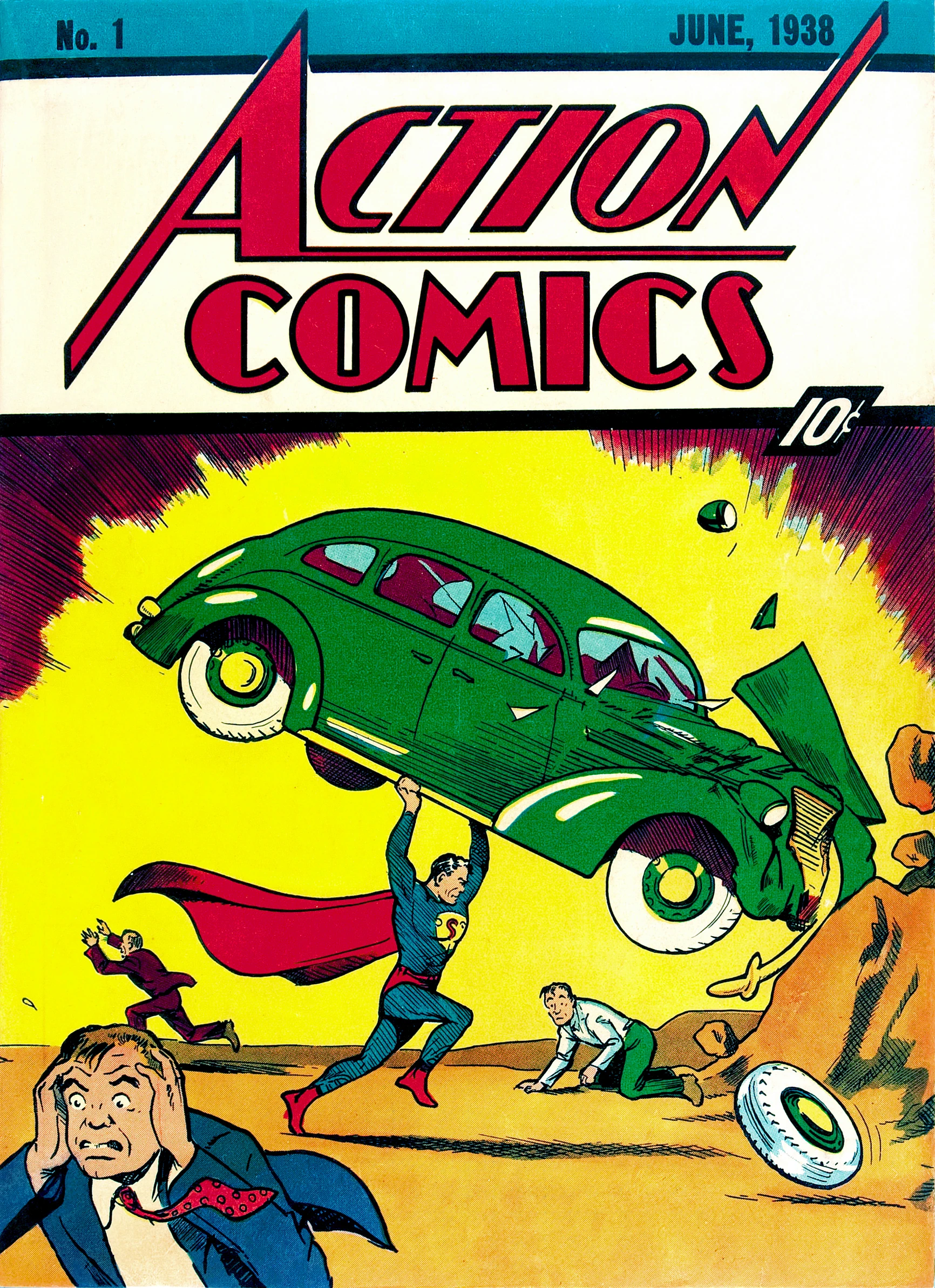
As a distant planet is destroyed by old age, a scientist places his infant son in a space capsule and launches it toward Earth. The capsule is found by a passing motorist, who brings the baby to an orphanage, where the child astounds the attendants with his superhuman powers. The child, who is named Clark Kent, can jump over buildings, lift enormous weights, and run faster than a freight train. Furthermore, his skin is impenetrable. Realizing that he has powers far beyond normal humans, Clark dedicates himself to fight crime and serve humanity as Superman, the champion of the oppressed.
Superman learns that an innocent woman named Evelyn Curry is to be executed for murder. He captures the real murderess, and delivers her, bound and gagged, to the governor's mansion. He breaks through the door to confront the governor and convinces him to call off the execution at the last minute.
At the *Daily Star*, where Clark works as a reporter, he's given the assignment to cover the stories about a man with amazing strength named Superman. He hears a tip about a wife-beating and rushes off to cover it -- then changes into Superman and stops the man before he kills his wife.
Returning to the Daily Star, Superman asks fellow reporter Lois Lane out on a date; she accepts out of pity. A thug named tries to cut in while Clark and Lois are dancing. To protect his secret identity, Clark pretends to be a cowardly weakling. Convinced that Clark is a spineless worm, Lois slaps Butch and walks out. Enraged, Butch and his friends leave the club and take Lois prisoner. Superman spots them and gives chase, smashing the car with his bare hands, terrifying Butch and his goons. He picks Lois up into his arms and carries her to safety. She's astonished, and the next morning, she tells her editor about her experience with Superman -- although she's even more cold to Clark than before.
The first "Superman" character created by Jerry Siegel and Joe Shuster was not a hero, but a villain. Their short story "The Reign of the Superman" concerned a bald-headed villain bent on dominating the world. The story did not sell, forcing the two to preposition their character on the right side of the law. In 1935, their Superman story was again rejected by newspaper syndicates wanting to avoid lawsuits, who recognized the character as being similar to a lead character from Philip Wylie's 1930 novel. DC decided to take a chance with Superman, figuring if any lawsuits were filed, they would just drop the feature. The revised Superman first appeared in Action Comics #1, June 1938. Siegel and Shuster sold the rights to the company for $130 and a contract to supply the publisher with material. The Saturday Evening Post reported in 1941 that the pair was being paid still a fraction of DC's Superman profits. In 1946, when Siegel and Shuster sued for more money, DC fired them, prompting a legal battle that ended in 1948, when they signed away any further claim to Superman or any character created from him. DC soon took their names off the byline. Following the huge financial success of Superman: The Movie in 1978 and news reports of their pauper-like existences, Warner Communications gave Siegel and Shuster lifetime pensions of $35,000 per year and health care benefits. In addition, any media production which includes the Superman character must include the credit, "Superman created by Jerry Siegel and Joe Shuster". Ever since 2013, legal rights matters have amended the credits with an additional statement: "By special arrangement with the Jerry Siegel family". [https://www.noblemania.com/2016/01/by-special-arrangement-with-jerry.html] Issue was released on April 18, 1938, which is also the date Doctor Manhattan attributed to Superman holding the car over his head in Doomsday Clock Vol 1 12. Also appearing in this issue of Action Comics was: * "'
Clark is given an assignment to go to San Monte, a war-torn South American republic. First, he goes to Washington, D.C., where he spies a slick lobbyist, Alex Greer, trying to convince Senator Barrows to involve the US in a war with Europe. Superman grabs Greer, and demands to know who he's working for. Greer refuses to talk, so Superman jumps up to the top of the Capitol building, and threatens to smash Greer to the ground.