
COMICBOOKSTOCKEXCHANGE.COM·
UTC LIVE TIMEDEAL RADAR
MARKET CLOCKS
HOME OFFICEHOME OFFICE--:--
NYSENew York--:--
LSELondon--:--
JPX / NIKKEITokyo--:--
DFM / ADXDubai--:--
WORLD / UTC--:--
Marvel·Captain America·#130·Bronze Age·ID-3229189
| Grade | Census & Float Distribution | Copies / Slabs | Role | FMV | Sales | Total Value | Multiple |
|---|---|---|---|---|---|---|---|
| 9.8 | 15 of 200 slabs (7.5%) | 15 | SOV | $432.00 | — | $6,480 | (63.3x) |
| 9.6 | 38 of 200 slabs (19.0%) | 38 | ANC | $475.00 | — | $18,050 | (69.6x) |
| 9.4 | 35 of 200 slabs (17.5%) | 35 | $101.00 | — | $3,535 | (14.8x) | |
| 9.2 | 24 of 200 slabs (12.0%) | 24 | $119.03 | — | $2,857 | (17.5x) | |
| 9.0 | 15 of 200 slabs (7.5%) | 15 | $15.00 | — | $225.00 | (2.2x) | |
| RAW | Raw Uncertified Copies | — | RAW | $6.82 | — | — | (1.0x Base) |
Empirical cash settlement intelligence, cross-grade elasticity curve, and secondary liquidation velocity.
Empirical step multipliers between adjacent condition tiers. Pinpoints the exponential premium transition and capital efficiency frontier.
Realized turnover cadence and capital absorption depth across certified auction comps.
Autonomous institutional strategies, financial equilibrium, scarcity modeling, and algorithmic risk profiling.
Market operates purely on organic buyer and seller auction discovery. Zero artificial price interventions or emergency liquidity halts on record.
Verified historical transaction line with quarterly equilibrium baseline anchor.
Understand how physical sales, invested dollars, and liquidity friction divide across grades.
Historical price records
Relative market value allocation
Estimated execution friction
Bibliographic provenance, creator credits, historical significance, and multimedia documentation.
? (ad copy)
?; ? (photographs)
?; ? (photographs)
? (background only)
Stan Lee
Home of Spider-Man, X-Men, Avengers, and the Marvel Cinematic Universe.
Comics grow darker and more socially aware. Wolverine, Punisher, Swamp Thing debut. Creator-driven storytelling emerges.
Newsstand variants carry meaningful scarcity premiums. First appearances from this era are blue-chip investments.
Bronze Age (1970–1984) — comics grew darker and more socially aware. The era of classic runs, creator-driven storytelling, and the birth of serious collecting culture. Newsstand variants carry a meaningful scarcity premium.
Inspectable mathematical proof, blockchain/ledger provenance, data integrity validation, and asset taxonomy.
A pricing discrepancy between an auction listing and the prevailing cleared consensus value across organized exchanges, allowing rapid liquidity capture before market equilibrium reconverges.
This issue opens with a flashy Captain America-vs-Hulk spectacle, but it quickly reveals that the fight is mostly a movie-screen image while Steve Rogers sits in a theater hearing younger viewers dismiss Captain America as outdated. Feeling disconnected and unsure of his place, Steve heads out on his motorcycle and runs into a tense student uprising at a nearby college, where police and protesters are clashing and the dean is trapped inside his office. Cap tries to calm everyone, but both sides distrust him, so he shifts from peacemaker to rescuer and uses his shield, quick improvisation, and a cable line to pull the dean to safety. The sequence emphasizes Cap’s central conflict in this era: he still believes in justice and dialogue, but he is caught in a country where institutions and protest movements are both angry, suspicious, and easy to provoke. A mysterious figure called the Hood is revealed as the one orchestrating events behind the scenes, manipulating public fear and trying to weaponize Captain America’s image. Disguised as a TV producer, he flatters Cap into giving a public statement about law, order, and social unrest, while secretly arranging to have him attacked on-air so chaos escalates. The Hood unleashes Batroc, Whirlwind, and Porcupine, turning the broadcast into a fast-moving supervillain ambush, but Cap fights through all three with classic agility and shield tactics before police arrive. Even though the immediate attack is contained, the villains’ escape and the Hood’s closing monologue make clear that this was only phase one of a larger plan, ending the issue on a cliffhanger that points to a deeper conspiracy targeting Captain America from behind the curtain.
Strict algorithmic segregation separating clean single-issue Cover A sales from multi-issue lot bundles, retailer exclusives, and foreign variants.

Captain America #1
9.8
$229.99
9.6
—
9.4
—
RAW
$2.49
Captain America #1
9.8
$175.00
9.6
—
9.4
—
RAW
$63.00
Captain America #1
9.8
$143.53
9.6
—
9.4
—
RAW
$55.87
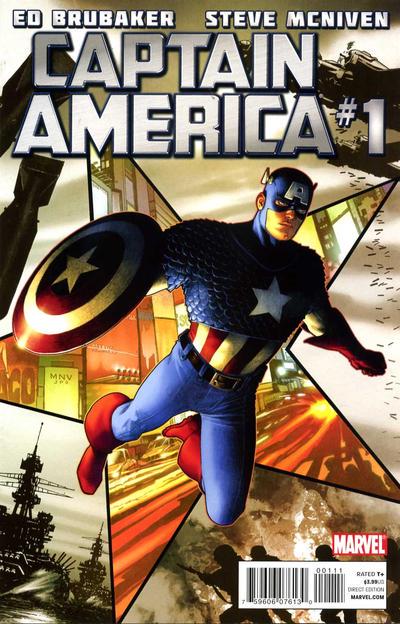
Captain America #1
9.8
$112.50
9.6
—
9.4
—
RAW
$8.99
Captain America #1
9.8
$109.98
9.6
—
9.4
—
RAW
$4.84
Captain America stumbles onto the Hood's plan to convince students to riot at a midwestern university.
Ad for model of Snoopy in his Sopwith Camel bi-plane.
Send for free booklet on how to finish high school at home.
This issue opens with a flashy Captain America-vs-Hulk spectacle, but it quickly reveals that the fight is mostly a movie-screen image while Steve Rogers sits in a theater hearing younger viewers dismiss Captain America as outdated. Feeling disconnected and unsure of his place, Steve heads out on his motorcycle and runs into a tense student uprising at a nearby college, where police and protesters are clashing and the dean is trapped inside his office. Cap tries to calm everyone, but both sides distrust him, so he shifts from peacemaker to rescuer and uses his shield, quick improvisation, and a cable line to pull the dean to safety. The sequence emphasizes Cap’s central conflict in this era: he still believes in justice and dialogue, but he is caught in a country where institutions and protest movements are both angry, suspicious, and easy to provoke.
A mysterious figure called the Hood is revealed as the one orchestrating events behind the scenes, manipulating public fear and trying to weaponize Captain America’s image. Disguised as a TV producer, he flatters Cap into giving a public statement about law, order, and social unrest, while secretly arranging to have him attacked on-air so chaos escalates. The Hood unleashes Batroc, Whirlwind, and Porcupine, turning the broadcast into a fast-moving supervillain ambush, but Cap fights through all three with classic agility and shield tactics before police arrive. Even though the immediate attack is contained, the villains’ escape and the Hood’s closing monologue make clear that this was only phase one of a larger plan, ending the issue on a cliffhanger that points to a deeper conspiracy targeting Captain America from behind the curtain.
Characters in this story also appear in other stories between this issue. The affected characters are:<br> From Pag. 1 to 15, Panel 3 Captain America (Steve Rogers)||Captain America Vol 1 132 From Pag. 15, Panel 4 to Pag. 20** Captain America (Steve Rogers)|Captain America Vol 1 132|