Japanese Candlesticks (Full Body & Wicks)Active Liquidity Center
Active market volume supports full candlestick distribution. Up-tails denote monthly high auction excursions; down-tails reflect monthly floor bids. Real-time deltas are displayed in the Hover HUD.
UP = Green Body + Up Tail·DOWN = Red Body + Down Tail·🔥 KILLER = Tall Green Surge·🚨 AWFUL = Deep Red Drop·⚪ FLAT = Tight Holding Month(Hover any candle to view exact Delta & High/Low)
Scroll to zoom · Drag horizontally to pan
Time Horizon Timeline ScrubberViewing: Full Historical Series
Candlestick Anatomy: Bodies span observed monthly Open to Close (Green = Up, Red = Down; flat dashes indicate unchanged monthly closes). Wicks appear only when verified auction sales or intra-month observations trade above or below the open-to-close range — zero synthetic padding.
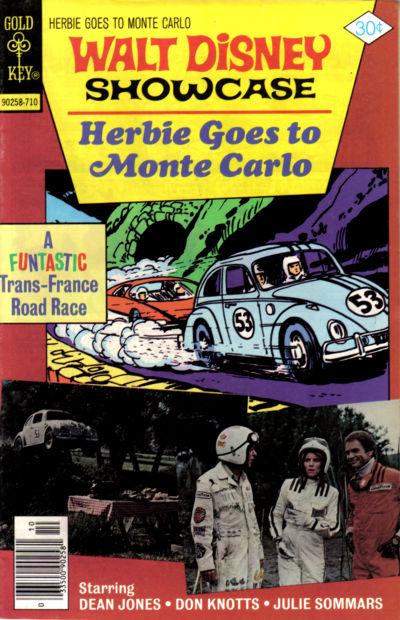
Walt Disney Showcase #41 (WDS41) — Monthlies, Quarterlies & LEAPS
MODEL BLACK–SCHOLES · 1-COPY CONTRACTS · 3RD FRIDAYS
Underlying: CGC 9.2 (Liquid Center) · Spot $65.08 · Model IV 36.9% · Open Contracts: 0
Walt Disney Showcase #41 (1977) Capital Math: Raw ($7.00) → CGC 9.2 ($65.08)
ISSUE-SPECIFIC GRADING & COST BASIS (Walt Disney Showcase #41):1. Surviving Condition Reality: For Walt Disney Showcase #41 (1977, Bronze Age), an average ungraded raw copy at $7.00 corresponds to a surviving 9.2 condition specimen—never a CGC 9.8 (zero CGC 9.8 copies exist on the census).2. CGC Modern ($30 tier) Fee Schedule: Encapsulating at $65.08 FMV incurs $30.00 CGC grading + $12.00 CCS pressing + $55.00 insured transit ($97.00 total grading hurdle), establishing an all-in cost basis of $104.00.3. Net Realized Spread: Clearing a certified CGC 9.2 at $65.08 ($31.06 net after eBay fee of $9.02 and insured shipping) generates -$72.94 (-70.1%)realized gain while eliminating uncertified restoration risk.
SECONDARY MARKET REALITY & BUYER STRATEGY:• OPTIMAL ENTRY TIER: Target Universal Blue Label CGC 9.2 ($65.08) to CGC 8.0 ($38.31) slabs. Buying raw at $7.00 exposes capital to color-touch, trimming, or married-page restoration rejection unless inspected in person.• CLEARINGHOUSE DEPTH: Secondary benchmark pricing spans from $7.00 (Raw) through $65.08 (CGC 9.2 modal anchor) to $0.00 (Apex).• ELASTICITY & FLOAT: Registered census scarcity stands at 4 total CGC slabs (scarce apex out of ~175,000 1977 print run). Cross-grade elasticity peaks on the CGC 6.0 → CGC 8.0 step (1.72× multiplier, +$16.01).
ISSUE LORE, CREATOR CANON & MACRO DRIVERS:• Bibliographic Authority: Published in 1977 by Gold Key, Walt Disney Showcase #41 is published by Gold Key, featuring Jim Douglas alongside Wheely Applegate, Diane, Herbie. Lead story: "Herbie Goes to Monte Carlo".• Float Lockup & Catalyst Horizon: Driven by Gold Key cross-media licensing and collector demand for Walt Disney Showcase and permanent scarcity (4 graded slabs, 0% slab penetration), institutional collectors treat top-condition copies as core key issue holdings.
Move cursor over chart to inspect dated transactions
Grade Census & Liquidity Breakdown
Grade Census & Liquidity Radial DecompositionBENCHMARK DEFINITION
Multi-axis radial distribution comparing trade velocity, capital weight, and bid-ask spread drag across certified grades.
Understand how physical sales, invested dollars, and liquidity friction divide across grades.
1. Liquid Float Anchor
$65.08 CGC 9.2
Modal CGC Census Liquidity Center (CGC 9.2)
2. Sovereign Benchmark
$65.08 CGC 9.2
Top-Pop Trophy Asset (Rare Census Slabs)
3. Ungraded Raw Copies
174,996 Copies
Print run minus all CGC graded | 4 Universal Slabs
4. Trailing 12M Sales
— Trades
88 lifetime verified comps on file
Filter Grade:
EMERALD LIQUIDITY
Sales Volume
Historical price records
88MARKET VOLUME
HOT PINK CAPITAL
Capital Weight
Relative market value allocation
$72.08LATTICE BENCHMARK SUM
FLAME FRICTION
Spread Drag
Estimated execution friction
31%AVG SPREAD COST
1. Sales Volume Share (Velocity)Identifies which grade tiers trade most frequently. High-volume tiers offer rapid liquidity and tight turnaround.
2. Capital Weight (AUM Concentration)Demonstrates where the total invested dollars sit. Top CGC tiers (up to 9.2) command the majority of total capital pool.
3. Spread Drag (Execution Cost)Reveals the dealer bid-ask spread friction for each grade, highlighting transaction cost penalties before committing capital.
Bronze Age (1970–1984) — comics grew darker and more socially aware. The era of classic runs, creator-driven storytelling, and the birth of serious collecting culture. Newsstand variants carry a meaningful scarcity premium.
Audit Trail & Verified Provenance
CRYPTOGRAPHIC AUDIT
Inspectable mathematical proof, blockchain/ledger provenance, data integrity validation, and asset taxonomy.
💼 PURCHASER DUE DILIGENCE & VALUATION FRAMEWORKRelative Value & Market Microstructure
A pricing discrepancy between an auction listing and the prevailing cleared consensus value across organized exchanges, allowing rapid liquidity capture before market equilibrium reconverges.
Direct Asset Application (Walt Disney Showcase #41):Dealer bids clear at $162.57 against a retail ask of $339.92 (52% spread). Purchasing near or below the wholesale floor allows immediate liquidation into dealer networks or secondary exchange rails with minimal duration risk.
Herbie Goes to Monte Carlo is a 1977 film, the third of a series of films by Walt Disney Productions starring Herbie, the white Volkswagen Beetle with a mind of its own.
The film stars Dean Jones as returning champion race car driver Jim Douglas, joined by his mechanic, Wheely Applegate (Don Knotts). They and Herbie are participating in the fictional Trans-France Race from Paris to Monte Carlo, Monaco in which they hope to stage a comeback.
As the film progresses, two thieves, Max () and (), steal the famous Etoile de Joie and cleverly hide it in Herbie's gas tank. It is also revealed that (Jacques Marin), also known as "Double X / XX," is the mastermind behind the museum robbery, though the fact of his scheme is revealed near the end of the movie. It is the eager young detective (Xavier Saint-Macary), of whom the Inspector is the superior officer, who unravels the mystery of L'Etoile de Joie, and has Bouchet clapped in handcuffs.
Notes & Official Promotional Trailer
Trivia:
*A copyright renewal for the film was registered on August 24, 2005.
Several different year Volkswagen Beetles were used for Herbie in the film. 1959, 1962, 1963, and 1977 (modified to resemble the 1963 model) models were utilized.
The following acknowledgement appears in the opening credits: "Our thanks to the City of Paris and the Principality of Monaco for their co-operation in the making of this film."
This Trans-France Race was clearly modeled on the world-renowned Monte Carlo Rally, and was apparently run in either 1976 or 1977, although no exact date is expressly stated in the film. Herbie was one of the 18 cars that started the race. While the precise number of competing cars in the race is open to debate, it is possible that twice as many race cars appeared in the movie.
Jim explains that it has been twelve years since he and Herbie's last race, in actuality, its only been nine since Herbie's last race in the original film, which was in 1968.
Herbie later echoes his move on Von Stickle in the Monte Carlo tunnel in Herbie: Fully Loaded, where he wins by driving on the catch fencing at the California Speedway.
The film was adapted into a paperback book, written by Vic Crume (based on the story and screenplay) and published by Scholastic. Oddly, his license plate on the front cover reads UKD 484 instead of the usual OFP 857. It also featured three characters unseen in the film: sportscaster Jackie Sanford, Race Commissioner and computer map designer Sir Reginald Harkness, and his assistant, Brewster. The name of a fourth character, driver Michael Hastings, was also mentioned.
The qualifying scenes were shot at Laguna Seca Raceway (which was also the scene of a major race in the first film). It is worth noting that Laguna Seca is in California, several thousand miles away from France.
L'Etoile de Joie (the name of the diamond) is French for "The Star of Joy."
The Porsche 917 in the movie (#17, driven by Bruno von Stickle) is not a real 917. It is based on a Volkswagen Beetle kit car called the Laser 917.
At the end of the first film, Jim and Carol Bennett were married; however, in this one, he is apparently single once again, given his romantic interest in Diane, although this is not addressed in the film.
Amendment - the Lancia Scorpion is the US-market version of the Italian-built Lancia Montecarlo and all Scorpions had 'headlight covers' (actually pop-up headlights) to meet US ride-height regulations. European cars (i.e. Montecarlos) did not have this style of headlight, but the covers were not added just for the film, they were a standard fitment on all Scorpions.
According to BoxOfficeMojo.com, the $29 million box office gross of the film came from its original 1977 release, combined with an additional $1 million from a limited re-issue in 1981.
The black car (#66) that leads most of the race before spinning out in the closing segments is a DeTomaso Pantera.
In the Trans-France Race, Douglas had three major opponents:
Bruno von Stickle (Eric Braeden): He is a dark-haired, mustached German driver with experience in the "European Racing Circuit." His car was a powerful Porsche 917 clone painted in the colors of the German national flag, and bearing the number 17. In fact, as referred in the movie, the kit car is a Lazer 917 GT coupé with numerous components including the engine and chassis from the Beetle. Von Stickle seemed to be a formidable contender prior to and during the race.
Claude Gilbert (Mike Kulcsar): He is a blond-haired French driver of unknown discipline, although it would seem likely that he was also a regular on the European Racing circuit. Gilbert, known for wearing a full-faced crash helmet, was the driver of an equally power-hungry De Tomaso Pantera. That car was black with white stripes and a number (#66) on the hood and the sides. His dominance in the race seemed similar to that of Bruno von Stickle—until he wrecked in the late stages (coincidentally, in almost exactly the same location of Grace Kelly's fatal car accident in 1982).
Diane Darcy (Julie Sommars): She is a very pretty, if somewhat icy, young woman with strawberry blonde hair and hazel eyes who initially hates Jim for his and Herbie's incompetence that ruined her chances during the qualifying race. Her car was an equally beautiful powder-blue 1976 Lancia Scorpion with yellow and white stripes, as well as a numeral 7. Her Lancia is a car with whom Herbie falls in love during the film. Jim seems to be similarly attracted to her as well. However, she does not appear to believe in cars with minds of their own; she thought this was merely an excuse for what she believed as an act of possible misogyny or sexism from Jim. Her feelings of hatred toward him were particularly evident in one scene wherein she tosses fine china at him, just to prove her value as a driver. While her nationality is unknown, it is probable that she is from either the United States or Canada. The only female driver in the race, she is ostensibly a rookie driver, although her level of racing experience is never discussed in the movie. Even so, she is truly a force to be reckoned with and is strictly a feminist. Relatively little was seen of her performance in the Trans-France Race itself.
Diane and the Lancia crash into a lake as a result of having "missed a shift and lost control"; Herbie, Jim, and Wheely save the woman and her car from drowning. She soon changes her attitude toward him after he saves her life and she witnesses Herbie towing her Lancia out of the lake. All three watch as Herbie crawls next to the Lancia and the two cars hold doors like holding hands. When Herbie seems to have trouble restarting, Diane urges the little car not to relent in their quest for victory in the Trans-France Race (with the added agreement of the Lancia's horn), and bids Jim good luck with a light kiss on one cheek.
Jim pursues Von Stickle through the streets of Monte Carlo, combatants in a thrilling duel for the win. In the end, though, Bruno von Stickle is overtaken by the little car in the famous tunnel of the Formula One race track, Herbie outracing him by driving upside down on the tunnel roof. Jim drives Herbie to victory for (also according to dialogue) the 20th time in their careers.
At the end of the film, Jim and Diane begin to fall in love, as do Wheely and the Monte Carlo trophy girl (Katia Tchenko). Most of all, Herbie and Giselle (Diane's Lancia, only referred to by name now as she comes to believe in cars with minds of their own) fall in love again as well.
The Lancia Scorpion, "Giselle" had headlight covers, but all Lancia Scorpions do not have headlight covers, so those were just added for the film. They were meant to simulate eyelids or eyelashes.
This is the first film to have Herbie fall in love, something he also does in Herbie: Fully Loaded.
The final segment of the race shows the cars drive the final 2/3 of the Monaco street circuit, a real-life racetrack famous for holding one of the most prestigious Formula 1 events, the Monaco Grand Prix. The track does actually go through a tunnel along the harbor front, although this tunnel does not appear in the film, as the grand prix tunnel lost its circular shape with after it was extended in 1973. Also, the finish line appears in front of the harbor, where it was located from 1955-1969, instead of the Avenue du Port, where it would have been in 1977.