
COMICBOOKSTOCKEXCHANGE.COM·
UTC LIVE TIMEDEAL RADAR
MARKET CLOCKS
HOME OFFICEHOME OFFICE--:--
NYSENew York--:--
LSELondon--:--
JPX / NIKKEITokyo--:--
DFM / ADXDubai--:--
WORLD / UTC--:--
Gladstone·Walt Disney's Donald Duck Adventures·#43·Modern Age·ID-3394004
| Grade | Census & Float Distribution | Role | FMV | Total Value | Multiple |
|---|---|---|---|---|---|
| 9.8 | 5 of 9 slabs (55.6%) | SOV | $12.18 | $60.90 | (1.0x) |
| 9.6 | 3 of 9 slabs (33.3%) | — | — | — | |
| RAW | 34,991 ungraded (35,000 printed − 9 graded) | RAW | $12.18 | $426,190.38 | (1.0x Base) |
Underlying: CGC 9.8 (Liquid Center) · Spot $12.18 · Model IV 60.0% · Open Contracts: 0
| Calls (Right to Buy 1 Copy) | Strike | Puts (Right to Sell 1 Copy) | ||||||||
|---|---|---|---|---|---|---|---|---|---|---|
| OCC Contract | Premium | Intr / Time | IV · Δ | Θ/d · ν | Strike $ | OCC Contract | Premium | Intr / Time | IV · Δ | Θ/d · ν |
| WDSD43-261218C9.5 | $2.75 | $2.68 + $0.07 | 68.5% · 0.94 | -0.01 · 0.00 | $9.50 | WDSD43-261218P9.5 | $0.05 | $0.00 + $0.05 | 68.5% · -0.06 | -0.01 · 0.00 |
| WDSD43-261218C11 | $1.46 | $1.18 + $0.28 | 61.8% · 0.78 | -0.01 · 0.01 | $11.00 | WDSD43-261218P11 | $0.26 | $0.00 + $0.26 | 61.8% · -0.22 | -0.01 · 0.01 |
| WDSD43-261218C12 | $0.81 | $0.18 + $0.63 | 59.2% · 0.58 | -0.02 · 0.01 | $12.00ATM | WDSD43-261218P12 | $0.60 | $0.00 + $0.60 | 59.2% · -0.42 | -0.02 · 0.01 |
| WDSD43-261218C13 | $0.38 | $0.00 + $0.38 | 57.8% · 0.35 | -0.01 · 0.01 | $13.00 | WDSD43-261218P13 | $1.18 | $0.82 + $0.36 | 57.8% · -0.65 | -0.01 · 0.01 |
| WDSD43-261218C15 | $0.06 | $0.00 + $0.06 | 57.6% · 0.08 | -0.01 · 0.00 | $15.00 | WDSD43-261218P15 | $2.85 | $2.82 + $0.03 | 57.6% · -0.92 | -0.00 · 0.00 |
Empirical cash settlement intelligence, cross-grade elasticity curve, and secondary liquidation velocity.
Empirical step multipliers between adjacent condition tiers. Pinpoints the exponential premium transition and capital efficiency frontier.
Realized turnover cadence and capital absorption depth across certified auction comps.
Autonomous institutional strategies, financial equilibrium, scarcity modeling, and algorithmic risk profiling.
Market operates purely on organic buyer and seller auction discovery. Zero artificial price interventions or emergency liquidity halts on record.
Verified historical transaction line with quarterly equilibrium baseline anchor.
Understand how physical sales, invested dollars, and liquidity friction divide across grades.
Historical price records
Relative market value allocation
Estimated execution friction
Bibliographic provenance, creator credits, historical significance, and multimedia documentation.
No narrative synopsis recorded in GCD for this sequence.
No creator data on record for this issue.
Gladstone is an indexed comic book publisher from the Modern Age tracked across the Panel Profits Sovereign Registry and CGC Census ledger.
Variant cover era. Trade paperback culture. Independent movement flourishes. Digital distribution begins.
Census-registered copies anchor pricing. First appearances of characters adapted to screen drive the market.

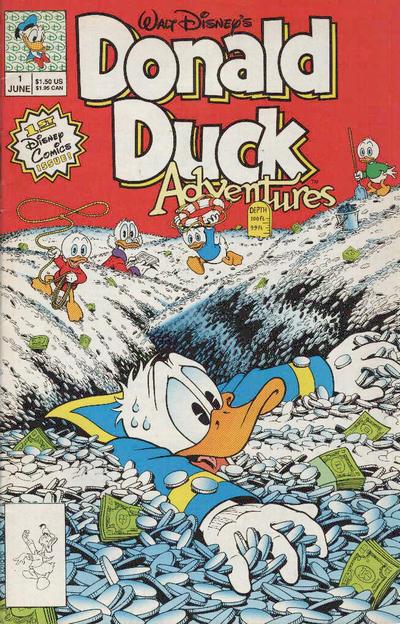


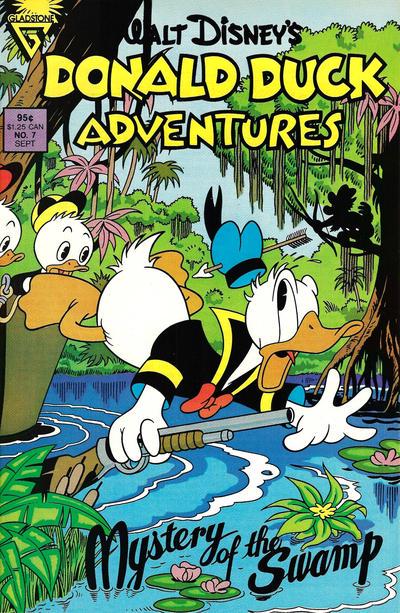


Modern Age (1992–present) — foil cover era, variant proliferation, and the independent movement. Strong narrative significance drives key issue demand. Census-registered copies anchor pricing.
Inspectable mathematical proof, blockchain/ledger provenance, data integrity validation, and asset taxonomy.
The recovery of third-party encapsulation and grading expenditures when an asset is acquired at a discount below the physical cost of replacement grading fees, shipping, and insurance.
Strict algorithmic segregation separating clean single-issue Cover A sales from multi-issue lot bundles, retailer exclusives, and foreign variants.
Walt Disney's Donald Duck Adventures #35
9.8
$124.95
9.6
—
9.4
—
RAW
$4.03
Walt Disney's Donald Duck Adventures #1
9.8
$104.26
9.6
$58.83
9.4
$47.60
RAW
$6.14
Walt Disney's Donald Duck Adventures #14
9.8
$99.00
9.6
—
9.4
—
RAW
$7.99
Walt Disney's Donald Duck Adventures #1
9.8
$88.00
9.6
$42.00
9.4
—
RAW
$6.98
Walt Disney's Donald Duck Adventures #21
9.0
$55.00
9.6
—
9.4
—
RAW
$3.72
Donald Duck Finds Pirate Gold, spelled on the cover with an exclamation mark, is a comic story written by Bob Karp with art by Carl Barks and Jack Hannah. It features Donald Duck, Huey, Dewey and Louie Duck, Yellow Beak, Peg-Leg Pete, Red Eye, and Red Eye's Brother. Henry Morgan, Jolly Roger, an , , and are mentioned.
Story Details & In-Universe References: • Donald Duck and his nephews start the story managign the Bucket o'Blood Sea Food Grotto, an inn of which Donald is identified as the owner. • Henry Morgan apparently once owned, or stayed in, the Bucket o'Blood, as the map to his treasure was hidden behind one of the bricks of the chimney. • Yellow Beak says he was told the location of the map to Morgan's treasure from an “old sailor” whose life he saved in a fight in Singapore, and who claimed to have gotten the map from Morgan's own ghost. • Peg-Leg Pete, Red Eye and his brother own a ship called the . It is temporarily renamed as part of Pete's disguise. • Also as part of Pete's con, is seen reading . is referred to as “Oliver” by Pete as part of the disguise; it is unclear if this is merely an alias, or actually Red Eye's birth name. • bought “one keg of crackers” on January the 12th and “one barrel of slumgullion” on January the 13th, both from the , which he is, by the time of the story, “long past due” paying for. (The items cost $4.25 and $6.40 respectively.) • The Ducks own a “Vacation Map”, on which , , , , , the , and the presence of “alligators” are marked out. • states that he plans to use his share of the treasure to buy a farm and become a “country gentleman”. • The cannonball the drop onto is marked out as being from “”. • Landmarks on include , , , and . • leaves a note to and instructing them to send his remains to “his in " if he should be killed while looking for the treasure”. • Yellow Beak explains that was killed in Bilge Water Cave by his first mate . was first printed in the 1942 #9, largely hailed as the first original Disney comic-book. It is also notable as 's first-ever Duck comic story (though contrary to popular belief, it is not outright his first Disney comic, as it is predated by ). The story was later reprinted in #250, #1, #7, ''Walt Disney's Comics in ColorDonald Duck and Uncle Scrooge - The Best And FirstsThe Biggest Big Walt Disney's ComicsCarl Barks LibrariesAyres & James Comics'' #2.
Donald Duck and Huey, Dewey and Louie Duck are swept from their seaside inn to the ends of the Earth by an old salt called Yellow Beak and his claims to possess a treasure map pointing to the desert island where Henry Morgan buried his treasure! Unfortunately, Peg-Leg Pete and his henchmen are hot on Yellow Beak's heels, and end up sneaking onto the boat the Ducks charter for their quest…
• This story was based on Harry Reeves and Homer Brightman's storyboards for the abandoned feature film concept Morgan's Ghost, themselves based on a story treatment by Dick Creedon and Al Perkins called Pieces of Eight (1939). The original concept was for a Mickey Mouse-Donald Duck-Goofy adventure; Karp's alterations of the storyboards into a comic script involved replacing Mickey and Goofy with Donald's nephews. • Better Little Books published their own storybook condensed version of the story, Donald Duck and Ghost Morgan's Treasure (1946). • Donald Duck and the Pirates (1947) borrowed the basic plot structure of Donald Duck Finds Pirate Gold, also bringing back the character of Yellow Beak himself, though the story is significantly shortened and most every plot detail is altered in some way. Thornily, Donald and Yellow Beak do not acknowledge already knowing each other in the story. • The same basic plot of ''Morgan's Ghost'' was recycled in The Seven Dwarfs and the Pirate (1949) and Captain Hook and the Buried Treasure (1953); as before, Yellow Beak is retained but the heroes are switched over. Woody, Knothead and Splinter Search For Pirate Treasure (1963) cast non-Disney star Woody Woodpecker in yet another variation on the same plot, although a looser one which acknowledges that this is not the first time Yellow Beak has been through this adventure. • Clipper Ship Caper (1961) also borrowed from the story (namely the hook of the protagonists unknowingly setting sail on a ship crewed by Pete and his henchmen, with Pete posing as a sweet old woman) but has a more distinct plot, and drops Yellow Beak altogether. • The Treasure of Yellow Beak (1957) was a sequel to the events of the 1942 story, with Donald Duck recognizing Yellow Beak immediately, but also borrowed the broad structure of the plot, with a journey on a ship where Peg-Leg Pete is present in disguise. • Donald Duck Finds Pirate Gold… Again! (1962) was also, for its part, a straight-up sequel to the 1942 story, featuring Yellow Beak and the Ducks meeting again for a whole new adventure. The 2011 localization of the story by Joe Torcivia adds dialogue wherein which Yellow Beak acknowledges the Seven Dwarfs, Peter Pan and Woody Woodpecker versions of Pirate Gold as all having happened linearly. • Old Jack's Island (2000), by Marco Rota, featured Donald, the triplets and Scrooge McDuck going back in time to the 17th century and meeting Henry Morgan at the hight of his piratical career. Although the events depicted do not match the backstory described by Yellow Beak in this story, Morgan was drawn wearing a hat identical to the one still adorning his skull in Pirate Gold, and with gaps in his teeth matching those visible in the Barksian skull, as a sly visual connection between the two high-seas adventures. • A 2019 narrative comment on Joe Torcivia's The Issue At Hand, written by Torcivia himself, furthered the “gag” of an endless parade of Pirate Gold remakes with various character, by referring to an in-universe comic book called Super Goof Finds Pirate Gold, which had accidentally been erased from Time by the Collective of the Retconning Crocodiles. • The above gag was itself referenced in the Crew of the Copper-Colored Cupids prose story Stranded at Memory’s End (2020), where the Blue Feather discover a copy of Super Goof Finds Pirate Gold in the Oblivion, a realm made up of things and individuals previously erased from the timeline of the Duck Universe.

