
COMICBOOKSTOCKEXCHANGE.COM·
UTC LIVE TIMEDEAL RADAR
MARKET CLOCKS
HOME OFFICEHOME OFFICE--:--
NYSENew York--:--
LSELondon--:--
JPX / NIKKEITokyo--:--
DFM / ADXDubai--:--
WORLD / UTC--:--
Gladstone·Donald Duck and Mickey Mouse·#4·Modern Age·ID-4784976
Underlying: CGC 9.8 (Liquid Center) · Spot $6.49 · Model IV 26.4% · Open Contracts: 0
| Calls (Right to Buy 1 Copy) | Strike | Puts (Right to Sell 1 Copy) | ||||||||
|---|---|---|---|---|---|---|---|---|---|---|
| OCC Contract | Premium | Intr / Time | IV · Δ | Θ/d · ν | Strike $ | OCC Contract | Premium | Intr / Time | IV · Δ | Θ/d · ν |
| DDMM4-261218C5.0 | $1.50 | $1.49 + $0.01 | 31.1% · 1.00 | -0.00 · 0.00 | $5.00 | DDMM4-261218P5.0 | $0.00 | $0.00 + $0.00 | 31.1% · -0.00 | -0.00 · 0.00 |
| DDMM4-261218C6.0 | $0.52 | $0.49 + $0.03 | 27.4% · 0.90 | -0.00 · 0.00 | $6.00 | DDMM4-261218P6.0 | $0.02 | $0.00 + $0.02 | 27.4% · -0.10 | -0.00 · 0.00 |
| DDMM4-261218C6.5 | $0.17 | $0.00 + $0.17 | 26.4% · 0.52 | -0.00 · 0.01 | $6.50ATM | DDMM4-261218P6.5 | $0.16 | $0.01 + $0.15 | 26.4% · -0.48 | -0.00 · 0.01 |
| DDMM4-261218C7.0 | $0.02 | $0.00 + $0.02 | 25.9% · 0.12 | -0.00 · 0.00 | $7.00 | DDMM4-261218P7.0 | $0.52 | $0.51 + $0.01 | 25.9% · -0.88 | -0.00 · 0.00 |
| DDMM4-261218C8.0 | $0.00 | $0.00 + $0.00 | 25.9% · 0.00 | -0.00 · 0.00 | $8.00 | DDMM4-261218P8.0 | $1.51 | $1.51 + $0.00 | 25.9% · -1.00 | 0.00 · 0.00 |
Empirical cash settlement intelligence, cross-grade elasticity curve, and secondary liquidation velocity.
Empirical step multipliers between adjacent condition tiers. Pinpoints the exponential premium transition and capital efficiency frontier.
Realized turnover cadence and capital absorption depth across certified auction comps.
Autonomous institutional strategies, financial equilibrium, scarcity modeling, and algorithmic risk profiling.
Market operates purely on organic buyer and seller auction discovery. Zero artificial price interventions or emergency liquidity halts on record.
Verified historical transaction line with quarterly equilibrium baseline anchor.
Understand how physical sales, invested dollars, and liquidity friction divide across grades.
Historical price records
Relative market value allocation
Estimated execution friction
Bibliographic provenance, creator credits, historical significance, and multimedia documentation.
No creator data on record for this issue.
Gladstone is an indexed comic book publisher from the Modern Age tracked across the Panel Profits Sovereign Registry and CGC Census ledger.
Variant cover era. Trade paperback culture. Independent movement flourishes. Digital distribution begins.
Census-registered copies anchor pricing. First appearances of characters adapted to screen drive the market.
Modern Age (1992–present) — foil cover era, variant proliferation, and the independent movement. Strong narrative significance drives key issue demand. Census-registered copies anchor pricing.
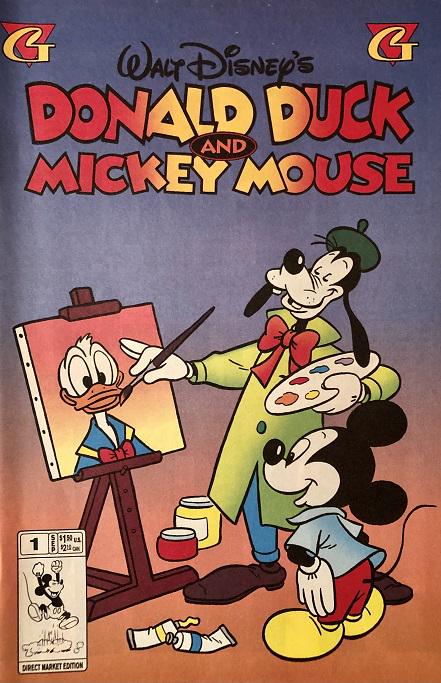
Donald Duck and Mickey Mouse #1
9.8
$56.23
9.6
—
9.4
—
RAW
$4.35
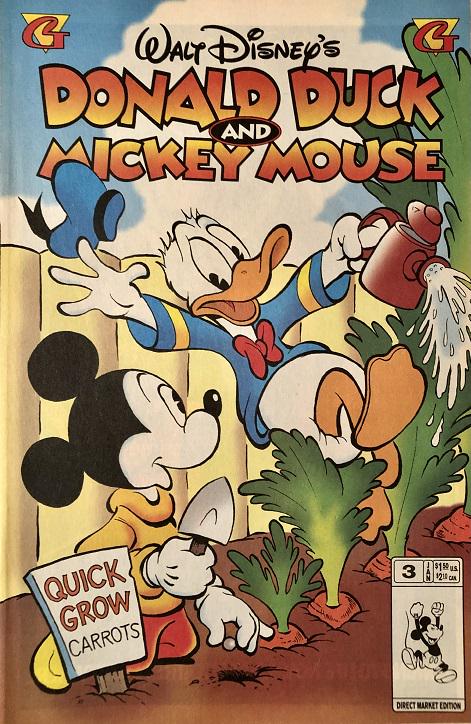
Donald Duck and Mickey Mouse #3
4.0
$6.70
9.6
—
9.4
—
RAW
$2.99
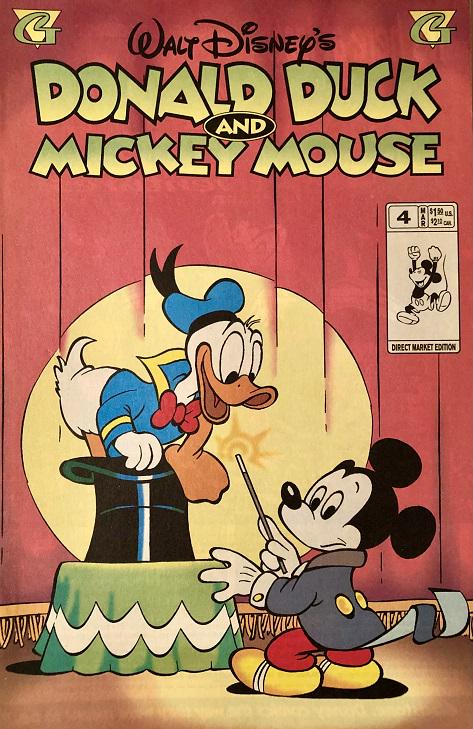
Donald Duck and Mickey Mouse #4
9.8
$6.49
9.6
—
9.4
—
RAW
$6.49
Inspectable mathematical proof, blockchain/ledger provenance, data integrity validation, and asset taxonomy.
The recovery of third-party encapsulation and grading expenditures when an asset is acquired at a discount below the physical cost of replacement grading fees, shipping, and insurance.
Strict algorithmic segregation separating clean single-issue Cover A sales from multi-issue lot bundles, retailer exclusives, and foreign variants.
'''''Disney's Mickey Mouse Works (commonly known shortened as Mickey Mouse Works or simply Mouse Works''''') was a short-lived American animated anthology television series that ran from May 1, 1999 to October 7, 2000. The series features the cartoon character Mickey Mouse and his friends in a series of animated cartoon segments in somewhat of an update of the classic Walt Disney cartoons. Mickey Mouse, Minnie Mouse, Donald Duck, Daisy Duck, Goofy, Pluto, and all star in their own cartoon segments. , , , , , , , , , , , and , all appear as recurring characters. Despite being faithful to the original shorts from the golden era, it also contained more wackier slapstick comedy, visual gags, wild takes, meta humor and cartoon violence similar to Looney Tunes and MGM cartoons (especially the Tom and Jerry and Tex Avery shorts) and other golden age-influenced cartoons around the 90's (Tiny Toon Adventures, Animaniacs, etc.).
Story Details & In-Universe References: {{Scroll2|}}<tabber> |-|Mickey Mouse Works= |-|Disney Television Animation= |-|The Disney Afternoon= </tabber> [pt-br:Ok Mundongo da Disney **Production:** [Roy E. Disney, chairman of the board of directors for The Walt Disney Company at the time, who was working closely with Walt Disney Television's Los Angeles-based senior vice presidents Barry Blumberg, Rick Schneider-Calabash, and Melinda Rediger, and executive producers Roberts Gannaway and Tony Craig, created an opening credits sequence in which music would be played by The Sensational Six characters, similar to the early golden age cartoons from the Mickey Mouse & Friends franchise, with soundtrack composed by Stephen James Taylor. Production began in January 1998, and a weekly half-hour series scheduled to premiere in March 1999 but ended up premiering in May, was produced by a currently-undocumented animation team assigned exclusively to create new cartoon adventures for Walt Disney's most famous cartoon characters. For a long time, Mickey Mouse Works was considered to be the first Disney animated television series to have episodes produced in a high-definition widescreen format, and that they aired cropped on the series itself. However, this was later proven to be false, as confirmed by both original and foreign TV airings, as well as home video releases. On , most of these cartoons were cropped when aired. However, some of the digitally-animated shorts have been remade in widescreen, using most of the original digital files. While the series itself generally uses digital ink and paint animation, seven cartoons (, , , , , , and ) were cel-animated, and so were produced in standard-definition but equally in a fullscreen aspect ratio and aired as such on the series. These seven cel-animated cartoons could easily be distinguished from the rest of the other cartoons made for the series, where they had a noticeably duller and darker color tint compared to the digitally-animated cartoons which had a brighter color tint, most likely due to a technical film-to-tape converting/transferring issue. While the series itself generally is produced entirely in traditional 2D animation, the series' opening credits sequence on the other hand combines both CGI animation and traditional 2D animation, with the backgrounds being rendered in CGI while the characters appearing in it are traditionally-animated. The series ended on October 7, 2000 with only a total of 28 episodes (96 segments, excluding repeats) due to low viewership during its initial broadcast. When the series was replaced by on January 13, 2001, many of the shorts were repeated on the new show, with some newly-produced cartoons airing for the first time, such as , and 's Big Movie ShowMouse Works'' opening and closing credits sequences. Two cartoons, , appear to be the only two cartoons that were not reused for , because of the latter's dark content. This is the first series where voices Daisy, specifically beginning with the infamous cartoon . Akun tehdas. Perhaps as a result of this, his spotlight-stealing gags in the opening credits sequence (known as and/or Mickey ManiaMickeymanía*, is also the name of features the original title card background on PAL prints of the cartoon, whereas on NTSC prints, the title card background is used for the cartoon. Similarly, features what appears to be a beta soundtrack on PAL prints of the cartoon, whereas on NTSC prints, the final soundtrack is used for the cartoon. To date, the latter is the only cartoon from the series with a known beta soundtrack, and it is currently unknown if other cartoons also have beta soundtracks. *As of 2026, the series, as well as its successor , have not gotten a release on yet. However, as stated earlier, the series used to be available to watch on Google Play, but it later got deleted along with (see reference link above). Perhaps as a result of this, an official digital purchase version of either series cannot be found anywhere. *The animation for the series was outsourced to , , and . However, despite this, one particular cartoon featured animation by instead of the formers, specifically being the cartoon . The reason for this remains obscure but is possibly because of originally being planned to be a theatrical cartoon, but remained unreleased. This series' premiere was on the same day as the long-running Nickelodeon series . *One particular cartoon featured as the voice of Mickey instead of , specifically being the banned cartoon . The reason for this remains obscure but is possibly because of 's scheduling at the time. *It was the last Disney Television Animation show of the 1990s.