COMICBOOKSTOCKEXCHANGE.COM·
UTC LIVE TIMEDEAL RADAR
MARKET CLOCKS
HOME OFFICEHOME OFFICE--:--
NYSENew York--:--
LSELondon--:--
JPX / NIKKEITokyo--:--
DFM / ADXDubai--:--
WORLD / UTC--:--
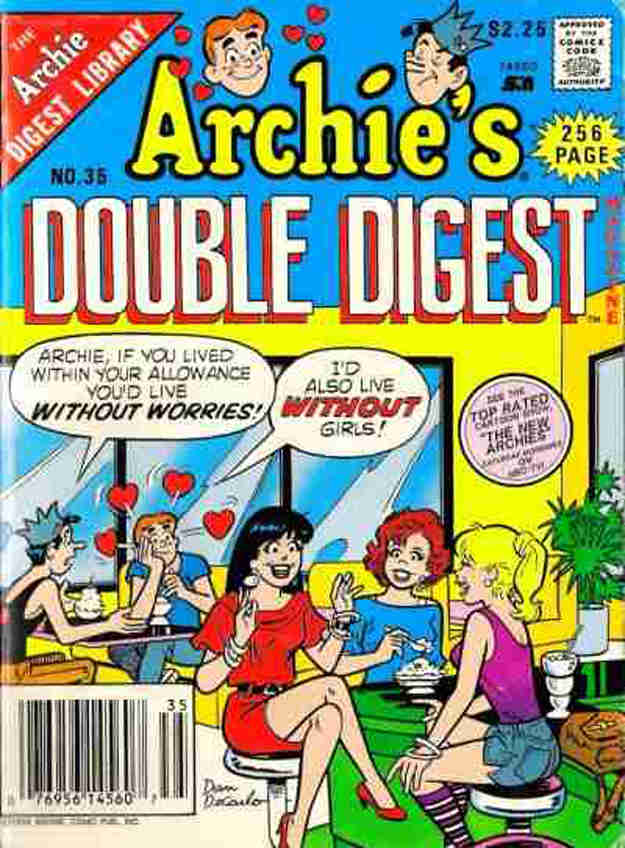
Archie·Archie's Double Digest Magazine·#35·Copper Age·ID-PPCF-0000098702
Empirical cash settlement intelligence, cross-grade elasticity curve, and secondary liquidation velocity.
Empirical step multipliers between adjacent condition tiers. Pinpoints the exponential premium transition and capital efficiency frontier.
Realized turnover cadence and capital absorption depth across certified auction comps.
Autonomous institutional strategies, financial equilibrium, scarcity modeling, and algorithmic risk profiling.
Market operates purely on organic buyer and seller auction discovery. Zero artificial price interventions or emergency liquidity halts on record.
Understand how physical sales, invested dollars, and liquidity friction divide across grades.
Historical price records
Relative market value allocation
Estimated execution friction
Bibliographic provenance, creator credits, historical significance, and multimedia documentation.
typeset; ?
No creator data on record for this issue.
Originally MLJ Magazines; home of Archie Andrews, Riverdale, Sabrina the Teenage Witch, and The Shield.
The direct market matures. Dark Knight Returns, Watchmen redefine the medium. Speculator boom begins.
High print runs mean condition is the key differentiator. 9.8 census numbers matter more than total prints.
Copper Age (1984–1991) — the speculator boom begins. Direct market matures, prestige formats launch. First appearances from this era have become blue chips. High print runs mean condition is the differentiator.
Inspectable mathematical proof, blockchain/ledger provenance, data integrity validation, and asset taxonomy.
The recovery of third-party encapsulation and grading expenditures when an asset is acquired at a discount below the physical cost of replacement grading fees, shipping, and insurance.
Archie prepares to duel Maurice in order to win back Veronica. He realizes Maurice is too good with a sword and too good with a pistol. He prepares to fist fight him, but a big lunk interferes and Maurice pummels him handily. Before they begin the official duel, Jughead insists Archie must slap Maurice's face with a glove. Jughead lets him use his baseball glove, which takes care of Maurice.
Strict algorithmic segregation separating clean single-issue Cover A sales from multi-issue lot bundles, retailer exclusives, and foreign variants.
Archie takes Mr. Weatherbee's advice to have some alone time and meditate but finds it difficult to avoid his friends.
After another disaster, Mr. Weatherbee saves time by having Archie explain while they walk to the detention room.
Archie, Betty and Jughead hike through the Sunkist Fun Fruits Jungle in search of a Brontosaurus who just happens to like processed fruit snacks.
Jughead's television watching seems to be affecting his dreams.
Hot Dog compares Jughead to a character on television.
Leroy blames Souphead for a broken window.
Jughead answers a question about cashing checks.
Jughead accidentally combines parts of his vehicle with Archie's and wins a race for energy efficient vehicle prototypes.
Archie offers to fix Mr. Lodge's car so he can get to his important meeting but Reggie sabotages his efforts. It works out for the best after Archie loans his car to Mr. Lodge and Reggie ends up getting a black eye from Smithers.
Archie and Veronica endure long lines to sample the new roller coaster at the carnival.
A homework assignment causes great fuss between Archie, Betty, and Veronica.
Archie and the gang come up with a D-U-H cheer, much to Mr. Weatherbee's disapproval.
Jinx is upset when Greg tells her that Gigi is moving away.
Archie's mother is the family politician: she is the "speaker of the house".
Archie predicts what Veronica will order.
Archie prepares to duel Maurice in order to win back Veronica. He realizes Maurice is too good with a sword and too good with a pistol. He prepares to fist fight him, but a big lunk interferes and Maurice pummels him handily. Before they begin the official duel, Jughead insists Archie must slap Maurice's face with a glove. Jughead lets him use his baseball glove, which takes care of Maurice.
Betty and Veronica unite to help out an underprivileged student unable to afford new clothes.
The vibrations from the music when the Archies practice is too much for Mr. Andrews.
Archie wonders what kind of a fool he is. He proceeds to demonstrate how he pursues the indifferent Veronica and dismisses sweet Betty.
Li'l Jinx breaks a mirror.
Archie is the umpire in the girls' baseball game.
Archie thinks he has a magic Egyptian scarab. But a series of misfortunes he suffers makes him think that the scarab is cursed.
Wilbur and Alec sneak off to fish without the girls.
Jughead paints a skateboarder and then eats a banana, throwing the peel behind him, causing the skateboarder to slip.
Melody's resemblance to the ancient Queen Nubila of Egypt causes a mummy to rise from the grave and pursue her in search of his true love.
Archie decides to ask Moose for permission to date Midge, incurring not only Moose's wrath, but that of Betty and Veronica as well.
Mr. Weatherbee wages a one-man war against the onset of spring fever at the school.
Archie can't understand why Betty lets Veronica insult her. Betty says that friends can be honest with each other. Archie decides to try it on Veronica, who becomes irate.
In a story punctuated by many ironic comments from the narrator, Archie and Veronica see old newspapers from the '20s and think that the world has been plunged into a new Depression.
Charley owns the team's football, but Russ owns the pump for it.
Betty tells the audience in verse how Veronica doesn't always have the advantage over her.
Dilton uses Archie's gasoline buying habits as an example when converting metric units.
When Archie and Veronica aren't speaking, Archie asks Betty to give a message to Ronnie for him, consisting only of the words "You, too!" This leads to an endless chain of angry messages until finally none of the kids are speaking to each other.
Jughead wins a piglet in a contest, and circumstances force him to bring it to school. The piglet promptly gets loose and soon the entire school is involved in trying to catch it.
The kids hold a flower show and want Jinx's father to judge.
Archie confronts Veronica about the fact that she's going out with other guys more than him, and she agrees to give him a chance to show her a better time than the others.
Betty and Veronica run into their old elementary school teacher, Mrs. Gamble, and find out what she's doing these days. They realize that the reason Mrs. Gamble gets so much cooperation from students is by pretending to be helpless.
Archie forgot if Veronica wanted to go ice skating or roller skating.
Reggie threatens to walk out of Veronica's life. Mr. Lodge offers to help him.
Jughead helps Moose move the fridge.
Archie brings a bird's nest to school for his science project, then is mercilessly pursued by the bird who was living in it.
Veronica and Betty demonstrate their different approaches to car repair: Veronica knows nothing about it, Betty knows too much.
Sabrina is determined to seduce handsome Bruce Van Klodd III away from her rival Rosalind without the use of magic potions - - until Rosalind begins beating Sabrina at her own game.
Li'l Jinx experiments with wearing high heels.
Archie's father can't make a putt. This is because the hole is really a paint can lid.
The school's computer has been damaging its input tapes. Mr. Weatherbee suspects "tape-worm".
Archie finds that the early '70s energy crisis has its advantages when a city-wide blackout traps him at the Lodges' house.
Jughead scares Reggie's hiccups away.
Reggie complains about a stupid TV show, while Moose finds it too challenging.
The newest fad is frying marbles. They are heated on the stove, then dumped into cold water which makes them cracked and sparkly and suitable for making jewelry. When Archie runs out of marbles, he manages to mistake a box of special vitamin balls made for Mr. Lodge's polo pony as a box of marbles.
Archie challenges Reggie, the school tennis champ, to a tennis match for the right to take Veronica to a dance.
Miss Beazly extinguishes Svenson's pipe with a soda siphon.
Li'l Jinx gets a new bath towel set full of helpful reminders.
Archie has one accident after another while hanging up safety posters.
Veronica replaces her entire wardrobe because her old clothes are out of style. But all the boys think the new sack-style dresses are hideous.
Betty and Veronica volunteer to teach Archie how to roller skate.
Jugheads umpiring is highly biased.
Mr. Weatherbee thinks Archie's fictional alibis are stranger than truth.
Mr. Lodge has a "punk" sense of humor.
Two girls are working in oils for Archie: a portrait painter, and Betty the mechanic.
Fred has lots of complaints at his checkup.
Betty is upset that Archie only has eyes for Veronica, even though Betty is well-dressed and Veronica is dressed for gardening.
Newspaper reporters are going to do a story on Veronica but bump into Betty doing recycling and decide to do a story on her instead.
Reggie hides from Moose in a trash can.
Betty believes that Archie's wall of Veronica pictures makes him only think he's in love with her. She expresses this belief in front of her wall of Archie pictures.
When Jinx says she's too tired to pick up her toys, her father says he's too tired to count out her allowance.
Betty and Veronica must confront their fears when they're on an island with a mysterious creature.
Veronica and Betty are concerned as Reggie and Archie choose swords as their weapons, but it turns out to be for roasting hot dogs, not dueling.
Jughead wants to stay inside and watch TV while Archie and Reggie try to get him to play baseball.
{{Character
:*"Lamont Cranston" redirects here. See The Lamont Cranston Band for the musical group. {{more footnotes|date=March 2012}} {{Superherobox | image = | caption = "Who knows what evil lurks in the hearts of men?" The Shadow as depicted on the cover of the July 15, 1939 issue of The Shadow Magazine.* The story, "Death from Nowhere," was one of the magazine plots adapted for the legendary radio drama. | character_name = The Shadow | publisher = Street & Smith Condé Nast | debut = Detective Story Hour (July 31, 1930) (radio) **"The Living Shadow"** (April 1, 1931) (print) | creators = Walter B. Gibson | alter ego = Kent Allard (print) Lamont Cranston (radio and film) | species = | homeworld = | Base of operations = New York City | alliances = | aliases = Lamont Cranston (print) | supports = | powers = -level intellect Peak mental and physical conditioning Master Skilled and Master of disguise Master of stealth Able to make himself nearly to the naked eye Can alter and control a person's thoughts and perceptions }} is a collection of serialized dramas, originally in 1930s pulp novels, and then in a wide variety of media. Details of the title character have varied across various media, but he is generally depicted as a crime-fighting with powers posing as a "wealthy, young man about town". One of the most famous adventure heroes of the twentieth century, The Shadow has been featured on the radio, in a long running pulp magazine series, in s, , , serials, s, and at least five s. The is well-remembered for those episodes voiced by .
Story Details & In-Universe References: • Cox, J. Randolph. Man of Magic & Mystery, A Guide to the Work of Walter B. Gibson, Scarecrow Press, 1998. ISBN 0-8108-2192-3. (Comprehensive history and career bibliography of Gibson's works.) • Eisgruber, Jr., Frank. ''Gangland's Doom, The Shadow of the Pulps'', Starmont House, 1985. ISBN 0-930261-74-7. • Gibson, Walter B., Tollin, Anthony. The Shadow Scrapbook, Harcourt Brace Jovanovich, 1979. ISBN 0-15-681475-7. (Comprehensive history of The Shadow in all media forms up through the late 1970s.) • Goulart, Ron. Cheap Thrills: An Informal History of the Pulp Magazine, Arlington House, 1972. ISBN 0870001728 • Murray, Will. Duende History of the Shadow Magazine, Odyssey Publications, 1980. ISBN 0-933752-21-0. • Overstreet, Robert. The Official Overstreet Comic Book Price Guide, 35th Edition., House of Collectibles, 2005. ISBN 0-375-72107-X. (Lists all Shadow comics published to date.) • Sampson, Robert. The Night Master, Pulp Press, 1982. ISBN 0-934498-08-3. • Shimfield, Thomas J. Walter B. Gibson and The Shadow. McFarland & Company, 2003. ISBN 0-7864-1466-9. (Comprehensive Walter Gibson biography with an emphasis on The Shadow.) • Steranko, James. ''Steranko's History of the Comics, Vol. 1'', Supergraphics, 1970. No ISBN. • Steranko, James, (1972), ''Steranko's History of the Comics, Vol. 2'', Supergraphics, 1972. No ISBN. • Steranko, James. Unseen Shadows, Supergraphics, 1978. No ISBN. (Collection of Steranko's detailed black-and-white cover roughs, including alternate/unused versions, done for the Shadow novel reprints from Pyramid Books and Jove/HBJ.) • Van Hise, James. The Serial Adventures of the Shadow, Pioneer Books, 1989. No ISBN. Development: Recognizing the demand and responding promptly, circulation manager Henry William Ralston of Street & Smith commissioned Walter B. Gibson to begin writing stories about "The Shadow." Using the of and claiming the stories were "from The Shadow's private annals as told to" him, Gibson wrote 282 out of 325 tales over the next 20 years: a novel-length story twice a month (1st and 15th). The first story produced was "", published April 1, 1931. Gibson initially fashioned the character as a man with villainous characteristics, who used them to battle crime, and in this was of the superhero, complete with a stylized imagery, a stylized name, sidekicks, supervillains, and a secret identity. Clad in black, The Shadow operated mainly after dark, burglarizing in the name of justice, and terrifying criminals into vulnerability before he or someone else gunned them down. The character was a in every sense; Gibson himself claimed the literary inspirations were 's and 's "The House and the Brain". Because of the great effort involved in writing two full-length novels every month, several guest writers were hired to write occasional installments in order to lighten Gibson's work load. These guest writers included — who penned the stories — and . In the late 1940s, mystery novelist Bruce Elliott (also a magician) would temporarily replace Gibson as the primary author of the pulp series. , a for Street & Smith, wrote two Shadow stories. ceased publication with the Summer 1949 issue, but Walter B. Gibson wrote three new "official" stories between 1963 and 1980. The first of these began a new series of nine updated Shadow novels from , starting with under his own by-line. But the remaining eight, , , , ''The Shadow's RevengeMark of The ShadowShadow Go MadNight of The ShadowThe Shadow, Destination: Moon'', were not penned by Gibson but by under the "Maxwell Grant" byline. In these last eight novels, The Shadow was given psychic powers, including the radio character's ability "to cloud men's minds" so that he effectively became invisible, and was more of a spymaster than crime fighter.
Introduced as a mysterious radio narrator by David Chrisman, William Sweets, and Harry Engman Charlot for Street and Smith Publications, The Shadow was developed fully and transformed into a pop culture icon by pulp writer Walter B. Gibson. The character would go on to become a major influence on the subsequent evolution of comic book superheroes, in particular, Batman.
The Shadow debuted on July 31, 1930, as the mysterious narrator of the Street and Smith radio program Detective Story Hour. After gaining popularity among the show's listeners, the narrator became the star of The Shadow Magazine on April 1, 1931, a pulp series created and primarily written by the prolific Gibson.
On September 26, 1937, The Shadow radio drama premiered with the story "The Deathhouse Rescue", in which the character was characterized as having "the power to cloud men's minds so they cannot see him." This was a contrivance for the radio; in the magazine stories, The Shadow was not given the literal ability to become invisible.
The introduction from The Shadow radio program "Who knows what evil lurks in the hearts of men? The Shadow knows!" spoken by actor Frank Readick Jr., has earned a place in the American idiom. These words were accompanied by an ominous laugh and a musical theme, Camille Saint-Saëns' ''Le Rouet d'Omphale'' ("Omphale's Spinning Wheel", composed in 1872). At the end of each episode The Shadow reminded listeners that, "The weed of crime bears bitter fruit. Crime does not pay... The Shadow knows!"