COMICBOOKSTOCKEXCHANGE.COM·
UTC LIVE TIMEDEAL RADAR
MARKET CLOCKS
HOME OFFICEHOME OFFICE--:--
NYSENew York--:--
LSELondon--:--
JPX / NIKKEITokyo--:--
DFM / ADXDubai--:--
WORLD / UTC--:--
Independent·Ragman·#2·Bronze Age·ID-22745
| Grade | Census & Float Distribution | Copies / Slabs | Role | FMV | Sales | Total Value | Multiple |
|---|---|---|---|---|---|---|---|
| 9.8 | 33 of 71 slabs (46.5%) | 33 | SOV | $80.68 | 33 | $2,662 | (22.5x) |
| 9.6 | 21 of 71 slabs (29.6%) | 21 | $30.00 | 21 | $630.00 | (8.4x) | |
| 9.4 | 7 of 71 slabs (9.9%) | 7 | $39.00 | 7 | $273.00 | (10.9x) | |
| 9.2 | 1 of 71 slabs (1.4%) | 1 | $47.26 | 1 | $47.26 | (13.2x) | |
| 9.0 | 2 of 71 slabs (2.8%) | 2 | — | — | — | (2.8%) | |
| RAW | Raw Uncertified Copies | — | RAW | $3.59 | — | — | (1.0x Base) |
Empirical cash settlement intelligence, cross-grade elasticity curve, and secondary liquidation velocity.
Empirical step multipliers between adjacent condition tiers. Pinpoints the exponential premium transition and capital efficiency frontier.
Realized turnover cadence and capital absorption depth across certified auction comps.
Autonomous institutional strategies, financial equilibrium, scarcity modeling, and algorithmic risk profiling.
Market operates purely on organic buyer and seller auction discovery. Zero artificial price interventions or emergency liquidity halts on record.
Verified historical transaction line with quarterly equilibrium baseline anchor.
Understand how physical sales, invested dollars, and liquidity friction divide across grades.
Completed market sales by grade
Relative market value allocation
Estimated execution friction
Bibliographic provenance, creator credits, historical significance, and multimedia documentation.
Robert Kanigher
Joe Kubert
Joe Kubert
Joe Kubert, Jack C. Harris
No narrative synopsis recorded in GCD for this sequence.
Publisher profile coming soon
Comics grow darker and more socially aware. Wolverine, Punisher, Swamp Thing debut. Creator-driven storytelling emerges.
Newsstand variants carry meaningful scarcity premiums. First appearances from this era are blue-chip investments.
Bronze Age (1970–1984) — comics grew darker and more socially aware. The era of classic runs, creator-driven storytelling, and the birth of serious collecting culture. Newsstand variants carry a meaningful scarcity premium.
Inspectable mathematical proof, blockchain/ledger provenance, data integrity validation, and asset taxonomy.
The recovery of third-party encapsulation and grading expenditures when an asset is acquired at a discount below the physical cost of replacement grading fees, shipping, and insurance.
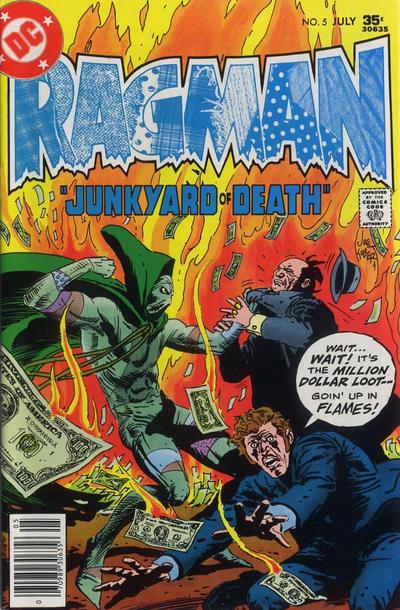
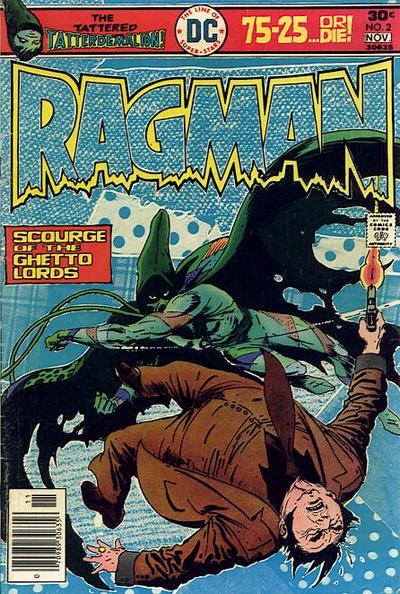
While seeking the money hidden in Rory Regan's junkyard, The Syndicate baits a trap for the Ragman with a captive woman. At the junkyard behind Rags 'n Tatters, Rory was wearing the Suit of Souls, which his late father had left for him. He was conversing with his father through the suit. Meanwhile, Kinky and Lukas, two gangsters in a car stopped by the junkyard, running away from the police. Next, Kinky exited the vehicle and took out a woman named Opal, who they were holding hostage and threatened to kill her unless the police dropped their weapons. Meanwhile, Lukas who was in the driver's seat, drove backwards, running over the two policemen, killing them. Next, Kinky attempted to re-enter the car with Opal, but Ragman appeared on top of the car, spooking Kinky away. Kinky attempted to shoot Ragman, but missed, shooting Lukas instead, killing him. Ragman jumped off of the car as it spun out of control and crashed. Suddenly, Kinky had Ragman at gunpoint and attempted to shoot him, however the vigilante, swooped the criminal off of his feet, got up, and punched him, knocking him unconscious. Next, Ragman turned his attention towards Opal, who claimed that she liked him. Suddenly, Ragman heard police sirens and told Opal that she could tell them what had happened. However, Opal asked when she would see him again, which he responded by telling her to forget him. Back at Rory Regan's house, he hung up his suit and replaced his bandages. Next, he examined a photograph of his late father, remembering that his father had promised to make him a mutli-millionaire, but he had inherited nothing, acting disappointed. Later, a girl named Eudora came into the shop, giving Rory her doll Diane. Next, Mr. Cohen came in, giving Rory his chess set, which he had lost the pieces to. Afterwards, Mrs. Wong offered to cut her hair in order to pawn it in as a wig. Later, Bette Berg appeared behind Rory, blocking his eyes with her hands, and asking him how long he was going to "deny her mother the pleasure of crying at their wedding." Then, the two shared a kiss. Bette claimed that Rory had changed after returning from Vietnam, which he claimed that "too many good guys died for nothing." Then, she insisted that Rory should become something other than a junk-man, which he claimed he could become nothing more and insisted the Bette forgot about him. Meanwhile, at the office of the criminal organization known as the Syndicate, a criminal named Vorst was requesting help from his boss Flowers in finding lost money, which the latter agreed to. Next, Flowers had his men bring in Opal and attempted to question her on Ragman's whereabouts, who they learned about from Kinky, who was in prison. However, she refused to tell them. The next day, at Rags 'n Tatters, a man came in to pawn a cuckoo clock. After several hours, Rory noticed the time on the clock and decided to rest. At midnight, Vorst and another man from the Syndicate touched down in the junkyard with a helicopter, discussing that the cuckoo clock contained an incendiary bomb. They attempted to place Opal in the middle of the junkyard to use as bait. Ragman took the bait and attempted to save Opal, which the criminals responded by attempting to ram them with their helicopter, which Ragman and Opal dodged. Next, Ragman grabbed onto their helicopter, grabbed one of its wheels, and threw it at the rotor, causing it to crash and explode. Before the helicopter could crash, Ragman jumped and landed on a pile of mattresses. Next, Ragman went to Opal, who embraced him and asked him who he was, which he responded that he was "just a rag-man."
Each cover variant, retailer incentive, and subsequent printing represents an independent atomic tradeable instrument with unique supply elasticity, barcode registration, and secondary market demand.
Strict algorithmic segregation separating clean single-issue Cover A sales from multi-issue lot bundles, retailer exclusives, and foreign variants.