COMICBOOKSTOCKEXCHANGE.COM·
UTC LIVE TIMEDEAL RADAR
MARKET CLOCKS
HOME OFFICEHOME OFFICE--:--
NYSENew York--:--
LSELondon--:--
JPX / NIKKEITokyo--:--
DFM / ADXDubai--:--
WORLD / UTC--:--
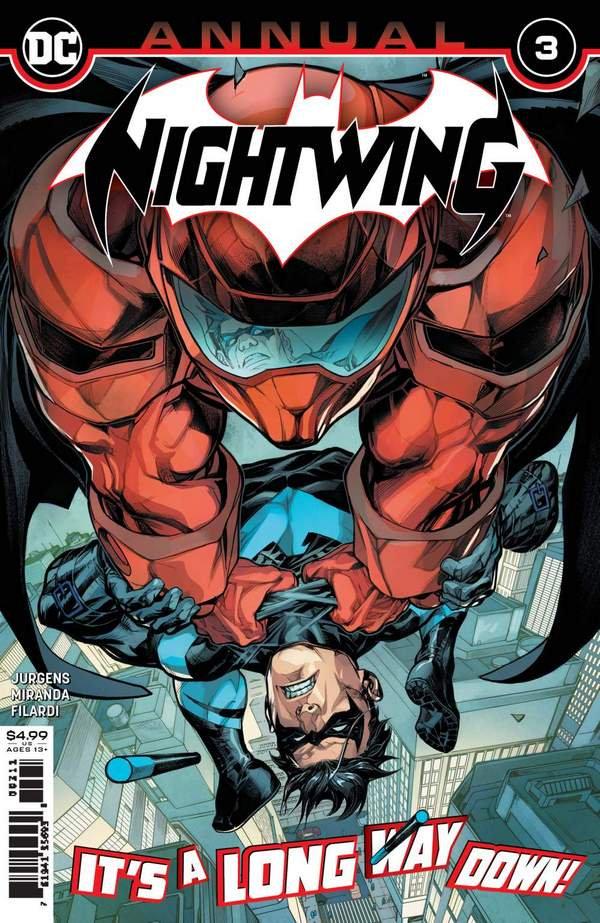
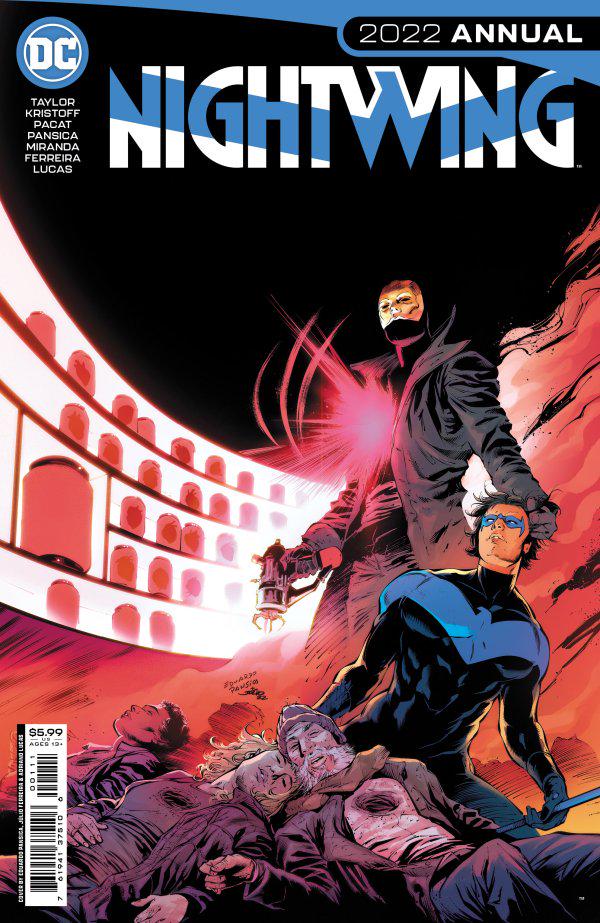
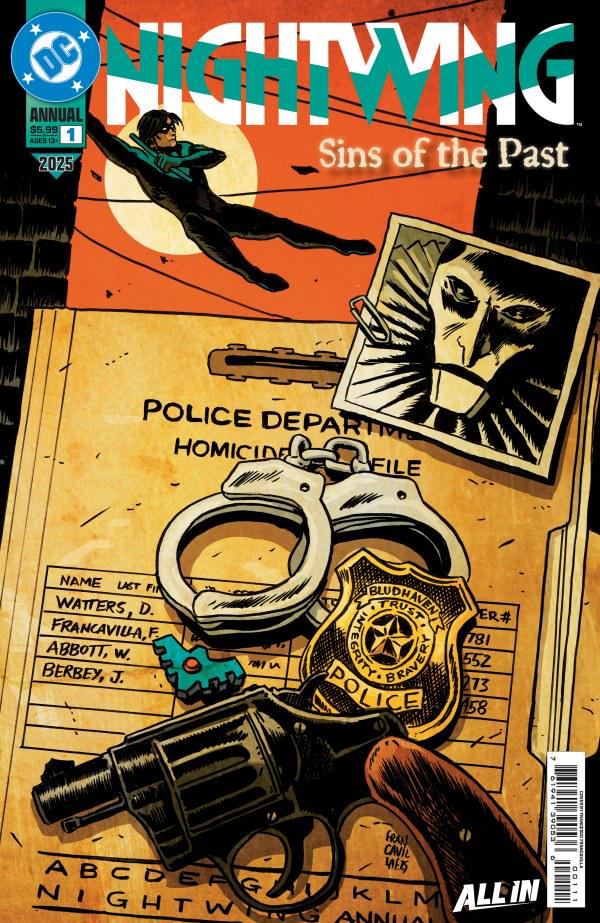
DC·Nightwing Annual·#1·Postmodern Age·ID-4395807
| Grade | Census & Float Distribution | Copies / Slabs | Role | FMV | Sales | Total Value | Multiple |
|---|---|---|---|---|---|---|---|
| 9.8 | 8 of 10 slabs (80.0%) | 8 | SOV | $26.30 | — | $210.40 | (2.6x) |
| 9.6 | 2 of 10 slabs (20.0%) | 2 | $29.00 | — | $58.00 | (2.9x) | |
| 9.4 | 0 slabs | 0 | — | — | — | — | |
| 9.2 | 0 slabs | 0 | $17.16 | — | — | (1.7x) | |
| 9.0 | 0 slabs | 0 | $2.00 | — | — | (0.2x) | |
| RAW | ~15,870 surviving raw (of ~22,685 printed) | 15,870 | RAW | $9.99 | — | $158,541 | (1.0x Base) |
Autonomous institutional strategies, financial equilibrium, scarcity modeling, and algorithmic risk profiling.
Market operates purely on organic buyer and seller auction discovery. Zero artificial price interventions or emergency liquidity halts on record.
Understand how physical sales, invested dollars, and liquidity friction divide across grades.
Historical price records
Relative market value allocation
Estimated execution friction
Bibliographic provenance, creator credits, historical significance, and multimedia documentation.
Benjamin Percy
Otto Schmidt
Otto Schmidt
Otto Schmidt
Katie Kubert, Jamie S. Rich, Dave Wielgosz
No narrative synopsis recorded in GCD for this sequence.
Home of Superman, Batman, Wonder Woman, and the Justice League.
Deconstructionist storytelling. Trade-first publishing. Creator prestige over character IP.
Value driven by creator reputation and adaptation potential rather than print scarcity.
Postmodern era — deconstructionist storytelling and trade paperback culture. Sustained demand comes from adaptations and creator prestige rather than print scarcity.

Nightwing Annual #2
9.8
$47.75
9.6
—
9.4
—
RAW
$7.90
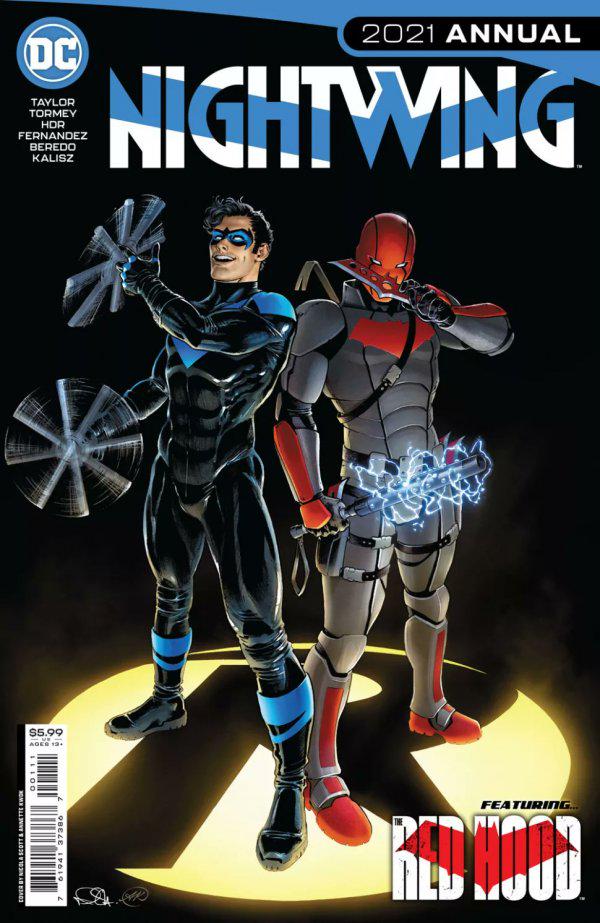
Nightwing Annual #null
9.8
$41.78
9.6
—
9.4
—
RAW
$26.95
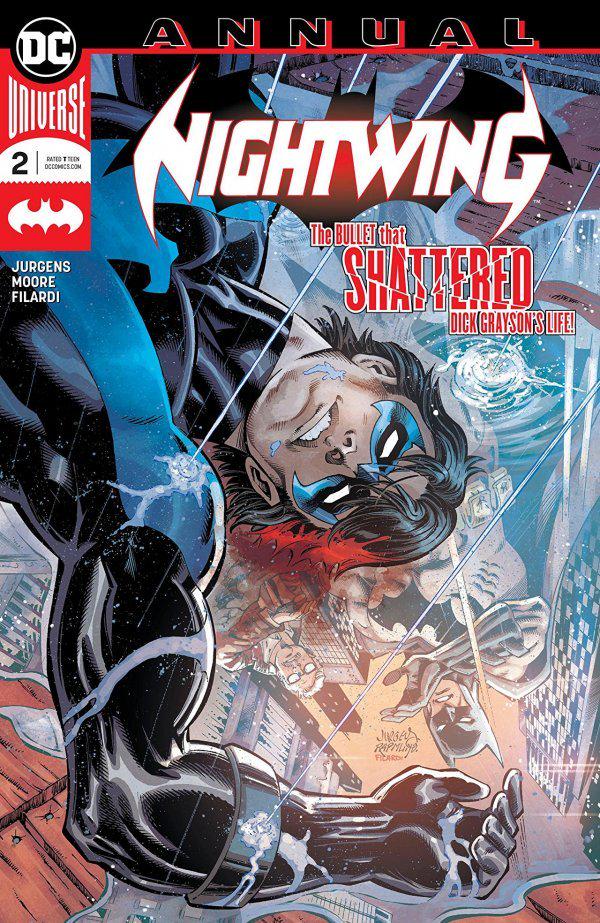
Nightwing Annual #2
9.8
$32.28
9.6
—
9.4
—
RAW
$12.04
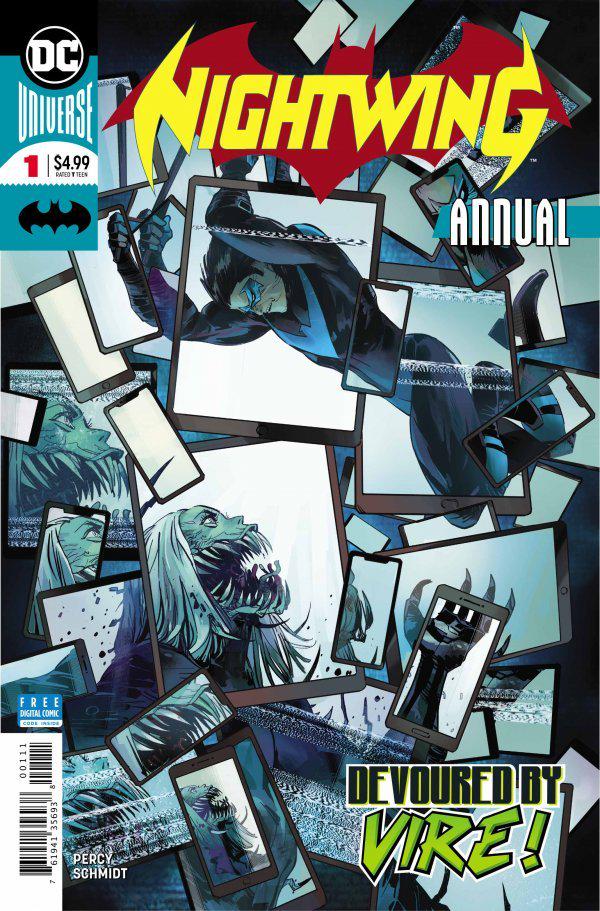
Nightwing Annual #1
9.8
$31.31
9.6
—
9.4
—
RAW
$9.99
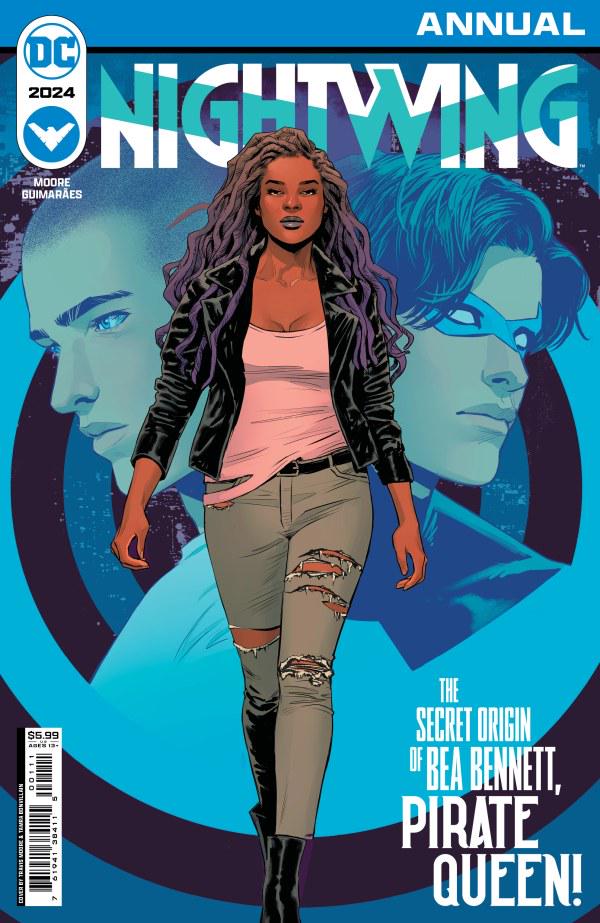
Nightwing Annual #1
9.8
$26.92
9.6
—
9.4
—
RAW
$9.99
Inspectable mathematical proof, blockchain/ledger provenance, data integrity validation, and asset taxonomy.
The recovery of third-party encapsulation and grading expenditures when an asset is acquired at a discount below the physical cost of replacement grading fees, shipping, and insurance.
Each cover variant, retailer incentive, and subsequent printing represents an independent atomic tradeable instrument with unique supply elasticity, barcode registration, and secondary market demand.
Strict algorithmic segregation separating clean single-issue Cover A sales from multi-issue lot bundles, retailer exclusives, and foreign variants.
“Do you ever... think about what things might've been like for us? If, you know, the timing didn't always suck?”
With Dick Grayson having decided to make the move to Chicago permanently, Barbara Gordon agrees to help him pack up his old Gotham City loft, musing at how strange it will be to have him gone. Even so, she understands his impulse to move after the dissolution of Haly's Circus, the discovery that he was meant to become a Talon of the Court of Owls, and the realization that Tony Zucco was still alive. Besides, Chicago is in a tumultuous state, and he feels he can do some good there.
As he packs, Dick spots a photo of himself with Barbara as Robin and Batgirl — identities that claims anymore. Barbara looks at the photo and sighs, feeling that life was so much back then. Now that her brother is dead, Batgirl is wanted for his murder, and her father — the — put her boyfriend into a coma. Sympathetic, Dick promises that if there is he can do, with respect to Ricky, she can talk to him. The moment becomes intimate, and Barbara wonders if ever thinks about what might have happened between them, if the timing hadn't always been so bad. Dick admits that he does, but the timing always suck — as it does now, with the shining in the night sky.
Bruce Wayne is out of town, leaving nobody to answer it but them. Dismissively, Barbara suggests that Dick should handle it without her — especially given how little she wants to deal with the GCPD right now. Dick is surprised, but Barbara warns that she's not Batgirl anymore. Compromising, he suggests that he go talk to the police, and then meet up with her later, insisting that he would like to have one last mission together before he leaves town.
Harvey Bullock explains on the rooftop that highly sought-after actress Cindy Cooke might be the target of an arsonist who has burnt down her production company and her talent agency in what is suspected were attempts on her life. Her ex-boyfriend Ted Carson was also burnt to death. Apparently, Cindy claims to know who is behind the arson, but refuses to speak to anyone about it but the Batman.
In meeting with Ms. Cooke on the roof of her penthouse, she explains that she has been in Gotham long enough to know that it's the freaks who deal with the other freaks best. She suspects that the freak in question is Garfield Lynns — a pyrotechnics professional who worked on some movies with her. She had to fire him a while ago, and he had not taken it well. She had been with Ted for four years, but the timing had been poor, and they'd had to break up. She had held out hope they'd get back together — until he was killed. The moral is not lost on Dick and Barbara.
On the set of Swordwalkers 3: The Reckoning, the film's director is surprised to learn that Dick and Barbara have broken into his trailer on account of the fact that he was the one who hired Garfield Lynns out of commercial work into the movie business — until he stopped showing up some days ago. Under pressure, the director admits that he assumed Lynns wasn't showing up because he is a heavy drinker. Fortunately, he does know the location of Lynns' workshop.
As they begin searching Lynns' loft, Dick suggests that the tension between he and Barbara could be resolved if they'd just take a chance, and go for it, regardless of the timing — which Barbara points out is the worst possible timing. Dick responds that perhaps what they need to do is accept that the timing is always going to be bad, and just make things work, so that they don't end up like Ted and Cindy, with regrets. He proposes that she move with him to Chicago, for a fresh start — together. Seeing the look on her face, he immediately retracts the offer, apologizing for his insensitivity, particularly with regard to Ricky's condition. Returning his mind to business, he discovers a scrap of paper on Lynn's desk, suggesting that the next target might be the Willowbrook Charity Dinner.
Bullock provides a SWAT team, prepared for any attack on the dinner. As they wait, Barbara comments that it is strange for someone to leave a note with the previous targets crossed off, and the next one left clearly spelled out — especially since this target isn't related to Cindy at all. Dick has a sudden realization that with every cop Bullock could muster here, nobody is protecting Cindy.
Fortunately, Dick and Babs arrive just in time to stop Lynns from setting Cindy on fire. As they fight, the arsonist insists that he will have Cindy. Unfortunately, there is some confusion in the flames, and they lose track of the actress just long enough to see a grenade ignite in front of her. Diving into the flames, Dick returns with the woman's charred remains in his arms — but they are not Cindy's remains. Somehow, Lynns switched out Cindy for Amy Stevens — her agent. Cindy's winded bodyguard explains that there is another exit through a panic room in the penthouse, and Lynns knew about it. Confused, Dick wonders how Lynns would have known about it, until he realizes what's really going on.
Elsewhere, Cindy regains consciousness, finding that she has been tied up. Firefly drops down in front of her explaining that he is sorry about the ropes, and intends to get them off as soon as possible. Confused, she begs for her life, and is surprised when he removes his helmet and explains that Garfield Lynns is dead. He — Ted Carson — is just putting his name to good use. Now, for all intents and purposes, they are both dead, and they will finally have the chance to be together, without the frustration of timing issues caused by her career. A career that he has essentially burned to death. Horrified, she explains that the fact that he would ever think she'd go along with this is proof that their relationship could never work. This enrages him, and it is only the quick action of Nightwing and Barbara that see him brought to justice.
Later, Cindy remarks that she almost wishes Ted had died in the first fire. He had never understood how her career had changed her life, and he resented it. The more successful she became, the more convinced he was that she chose her career over him — and honestly, he put so much pressure on her that she did. At the end of the day, she considers, when two people are meant to be together, it will just happen — but not if it's forced.
Returning to Barbara, who was waiting away from the crime scene to avoid the police, Dick tries again to apologize for trying to push her to move with him. She responds, though, that he was right. She is tired of pushing their relationship aside, despite the confusion and moral obligation she feels with Ricky in a coma. Unsure of how to respond, Dick stammers until she suggests that they really talk about it in the morning, after sleeping on it.
The next morning, Barbara knocks on the door of Dick's loft to find it unlocked, and the apartment empty. He has already left for Chicago without talking to her. She calls him, and he tries to make excuses but she admits that they both knew where the conversation would go. He couldn't stay, she couldn't leave. Despite that, they both still care about each other. Sighing, Dick hangs up, glancing over at the old photo of them, sitting in the empty seat next to him.
Their first date had been a good start. He had brought a camera with him, and Barbara had found that endearing enough to kiss his cheek as he released the shutter.